[JK:I received this release from the Saratoga Springs Rental Rights Alliance, raising concerns regarding the initiative for managing the city’s short-term rentals. It includes a petition to sign.]
We, the undersigned residents and concerned citizens of Saratoga Springs, NY, hereby express our strong opposition to rushed legislation aimed at restricting or regulating short-term rentals within our community.
Saratoga Springs Rental Rights Alliance Calls for ‘Caution and Common Sense’ as the City Addresses Short-Term Rentals.
The Saratoga Springs Rental Rights Alliance is a nonpartisan group of concerned citizens who are calling for the city to slow down, stop, and think before proceeding with proposed short-term rental regulations. The proposed regulations consist of nine pages of new requirements, including permit fees, applications, site plans, insurance requirements, inspections, and legal liability for homeowners who engage in short-term rentals within the City of Saratoga Springs.
Short-term rentals are part of the fabric of Saratoga Springs, with the tradition of track rentals spanning back decades as a way for homeowners to supplement their income. It must be noted that short-term rentals are not, and have never been, illegal in the City of Saratoga Springs.
The SSRRA is asking the city to slow down and examine the impact of the proposed rules on the city’s economy. Specifically, the SSRRA is concerned about the impact that the proposed regulations will have on the lodging base in the city during the peak tourist season that supports so many of our vibrant businesses and restaurants.
Furthermore, the SSRRA is concerned that the proposed regulations will have a disproportionate impact on residents who rent their properties for only a few weekends every year. Those residents may be priced out of participating in STRs in the face of onerous regulatory requirements. Notably, while STRs will have to pay a $1000 biannual registration fee under the proposed law, the application fee for a large hotel (100+ rooms) is merely $150.
Additionally, it is well-known that STRs are commonly used by families who are priced out of more expensive hotel accommodations, and eliminating or decreasing the STR stock will limit the availability of Saratoga Springs as a destination for many of our seasonal visitors and workers.
The SSRRA is asking for the following:
1. A study of the impact of the proposed regulation on the city’s economy.
2. A thorough examination of the cost of the proposed regulations and the city’s ability to carry it out.
3. The establishment of a cross-sectional working group to examine the proposed regulations and proposed agreeable changes.
4. A reconsideration of the $1,000 fee.
5. A reconsideration of the requirement that rentals be ‘owner-occupied’ as that term is defined in the proposed regulations.
The SSRRA will be conducting a press conference on Monday, March 4th at 11:30am on the steps of City Hall and invites all interested parties to attend.
[JK: This has been a particularly challenging post to write because there are so many errors and misrepresentations in the twenty-eight pages of the Attorney General’s report. After days of working on this, I realized that rather than drag the reader down the rabbit hole that is this report, it would make more sense to select representative items rather than write an opus.
I encourage followers of this blog to read the original report themselves:
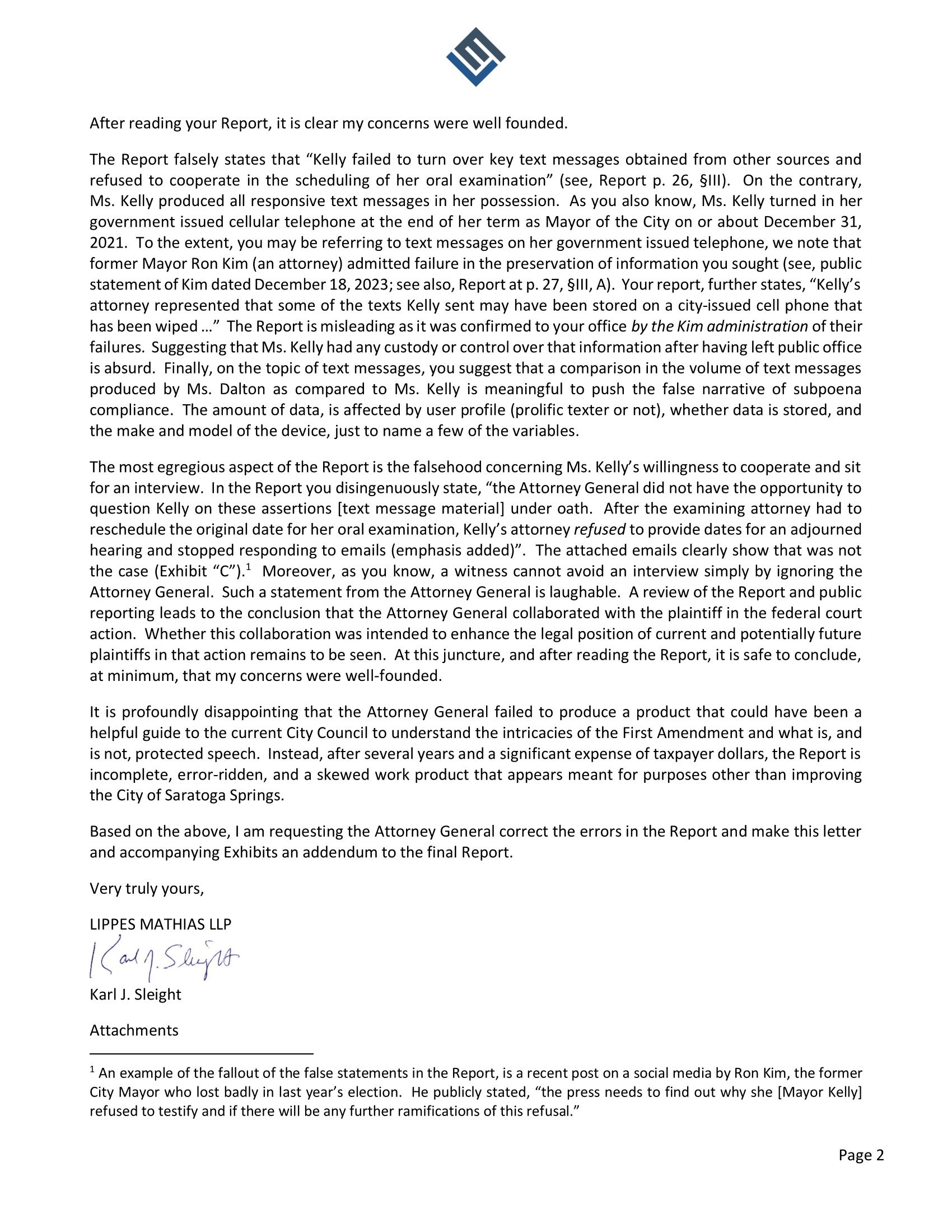
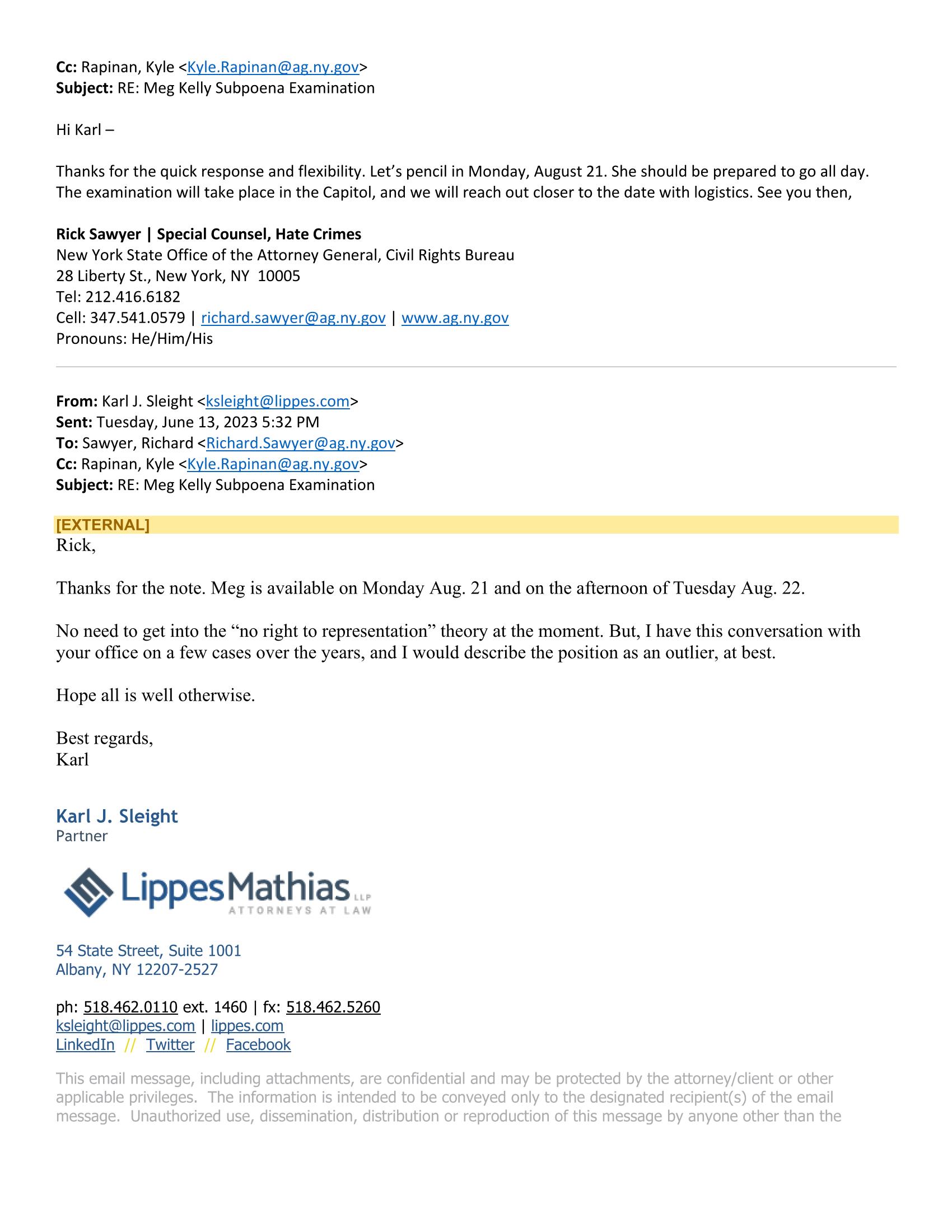
I would also encourage people to read the letter from Meg Kelly’s attorney, Karl Sleight, to the report’s authors and their email exchange, which are included at the end of this post. I credit Sleight for being a considerably more skilled writer than myself, and clearly, he knows more about the law than this blogger.]
The Attorney General’s Report on the Saratoga Springs Police Department’s Response to Protests in 2021 has been released. It is dated February 20,2024.
The report is riddled with inaccurate information and misrepresentations, utterly failing to support its basic scathing conclusion.
Sadly, this report was a lost opportunity to have honestly and objectively explored the issues that have plagued the city since Black Lives Matter became active here. The Attorney General could have provided advice on how best to address the blocking of city streets and the disruption of the deliberations of the City Council. Instead, they have cherry-picked from the information gathered while accepting at face value the testimony of BLM activists to throw together a document that pillories city officials and the Saratoga Springs Police Department.
Glaringly missing from the report is, with one minor exception, any acknowledgment that the city had struggled for four years to address the illegal activities of the local BLM, including repeated demonstrations that occurred without permits and illegally blocked city intersections for hours and the repeated disruption of City Council meetings leading to their abrupt adjournments and the inability of the Council to conduct city business.
Unsubstantiated Allegation That The Police Department’s Policy Was To Suppress BLM’s First Amendment Rights
The central theme of this report is their allegation that the city’s focus was to ruthlessly suppress the First Amendment rights of BLM.
“The Attorney General concludes that, in 2021, Dalton, Kelly, and Crooks implemented an unconstitutional official policy of retaliating against BLM protesters based on their speech.”
Executive Summary Attorney General Report, p.1
This is a truly outrageous statement that is simply not supported by the facts put forward in the AG report. If this were an “official policy,” where is the citation for this “policy” in the AG’s document? Where is the City Council resolution? Where is there a Charter reference? Where is there any evidence in the Council’s minutes? Every “official policy” I know of is stated somewhere in a written document. The creators of this AG report claim they reviewed “approximately (JK:?!) 276,809 documents” (p.1), yet they failed to cite one document that supports this. No such document is cited because it doesn’t exist. This hyperbolic assertion calls into question the very integrity of the report.
There are court cases that have broadened the meaning of “official policy.” Without going too far into the weeds, the AG cites a legal case but does not explain how the standard established in that case applied to the events described in the report. I submit that they exploited the term “official policy” to add gravitas to their allegations.
Their central problem, though, remains that they failed to provide credible proof that any elected officials were motivated by a desire to silence BLM’s freedom of speech rather than address how to manage the disruptions in our streets and in city hall.
Amazingly, the report fails to even consider the possibility that the actions of the SSPD might have been to address the repeated illegal blocking of city streets and the routine disruption of the City Council meetings.
BLM-Innocent Victims??
The AG exploits the situation of a city struggling with an unprecedented wave of provocative demonstrations, if not always getting it quite right, to falsely accuse officials of deliberately initiating a campaign to deny BLM their constitutional rights.
Buried in the report and absent from media coverage is the fact that BLM had been allowed on seven occasions to demonstrate without permits and illegally block city streets for hours while, as the report concedes, the police protected the demonstrators from traffic without interference(p.2, p6).
The report emphasizes the fact that during these demonstrations, BLM was not cited for hurting anyone or for any destruction of property. It fails to acknowledge how volatile and fraught the demonstrations were. Most critically, it fails to acknowledge the important role of the Saratoga Springs Police Department in effectively protecting the members of BLM along with the public. The potential for violence that the police had to address, after all, was not just from the BLM people but also from opponents of BLM.
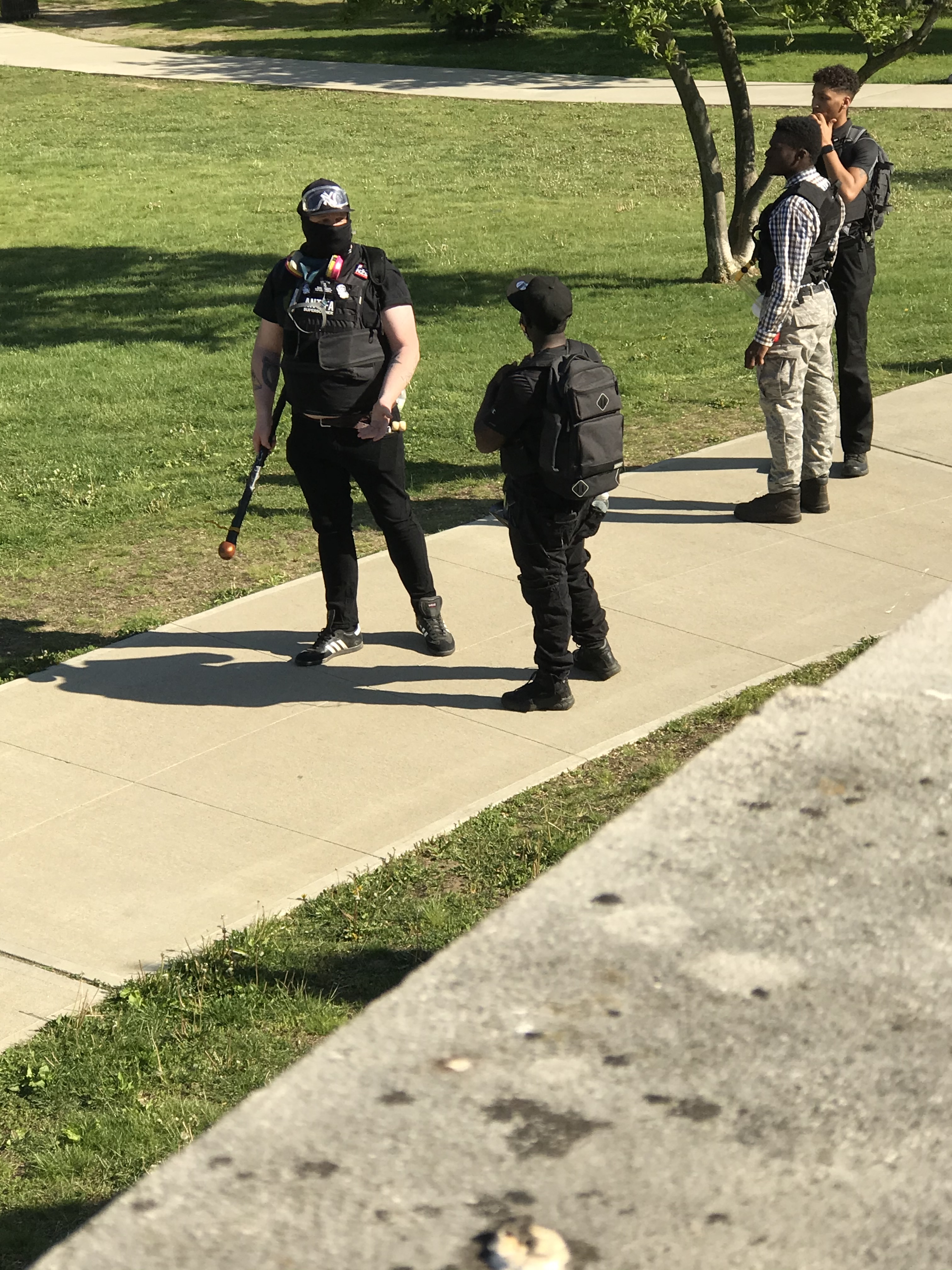
Consider this picture of a BLM activist in body armor and carrying a club at one of the demonstrations in Congress Park:
or this:
[Lexis Figuereo is separated from a Schenectady minister by police and sheriffs as Figuereo curses and taunts the minister. Without the police intervention, this would probably have erupted in violence.]
When the report does touch on BLM behavior, it is either dismissive of any possible danger posed by the actions of the demonstrators, calling their actions “raucous” but “peaceful”, or misrepresenting the intent of their actions. In one example, the narrative in the AG report alleges that the arrests made during the July 14 demonstration were unfairly made because the demonstrators “dispersed” following the warnings issued by the police that their occupation of Broadway at its intersection with Church Street was unlawful. The disingenuous use of the term “disperse” suggests that they honored the order and removed themselves from the street. What the demonstrators actually did, which I personally witnessed, was simply move out of the intersection and head south, remaining in the street, continuing to taunt the police, and continuing to block traffic.
It is important to note also that during this period of BLM actions, then-Mayor Meg Kelly felt sufficiently threatened that she wore a bulletproof vest. Then-Public Safety Commissioner Robin Dalton had to move her family out of their home to another location for a period of time because of threats she received. Citizens were expressing discomfort at attending City Council meetings where BLM was routinely shouting down speakers with whom they disagreed and aggressively approaching City Council members and grabbing microphones.
There is little doubt that the frustration of our city government and the public, in general, increased as the costs and dislocations of dealing with BLM’s disruptions went on.
The Free Speech Issue
The report relies on remarks from a press conference involving then-Public Safety Commissioner Robin Dalton and Lieutenant John Catone to make the case that the police acted to suppress the BLM people’s First Amendment rights. A careful reading of the report provides not one other example of statements or other materials from any police officer or public official that support this allegation.
Catone told attendees at a press conference that he planned to:
“…pull out every single connection my family has made over the last 130 years, and…stop your narrative.
You’re either with us or you’re not. And if you’re not, then you’re part of the problem.”
Lieutenant John Catone, June 28, 2021
How, then, do you explain that the AG never subpoenaed or interviewed Catone?
In all likelihood, they did not want to muddy their narrative by having to include any qualifying statements from Catone. Again, an interview with Catone would have been essential if this were a fair, objective, and vigorous investigation into the events.
Confusing Free Speech With Illegal Action
The question the AG’s investigation never addresses is whether blocking streets is a protected form of free speech. Nor do they address whether disrupting City Council meetings is a protected form of free speech. The AG simply assumes that any interference by the city to clear its streets or to take action against individuals disrupting its Council meetings is a form of suppression of free speech. There is no acknowledgment that for many who observed the continued disruptions of City Council meetings and the taunting and interruptions of speakers with whom BLM disagreed, it appeared that the right of free speech was exclusively theirs.
The Document Contains Information Which Is Simply Not True
The AG’s report contains errors of fact, which call into question the credibility of the report and the thoroughness of those who wrote it.
One of the glaring errors occurs on page 2 of the report in the description of an encounter between BLM and law enforcement on July 30, 2020.
The logistics for managing this street demonstration were carried out by a joint operation that included the officers of the Saratoga Springs Police Department, the New York State Police, and the Saratoga County Sheriff’s Department. As the AG report purports to have investigated the alleged abuse of demonstrators at this event, it would seem axiomatic to get the take from the State Police and the Sheriff’s Department regarding what happened and what they thought about the Saratoga Springs Police Department’s performance. Yet the investigators never bothered to contact either of these other law enforcement agencies equally involved in the response to BLM.
If they had, for one thing, the authors of the report might not have erroneously reported that the city police were in military riot gear, fired pepper balls at the demonstrators and that the armored vehicle that was deployed at a demonstration belonged to the city. (This error was reported to the AG by Public Safety Commissioner Tim Coll, and the AG was forced to correct the record).
I submit that the reason the AG did not interview the Sheriff’s department or the State Police was:
The report would have been forced to acknowledge that according to these other law enforcement agencies, the reason for the arrests was not to suppress BLM’s freedom of speech but instead to manage the illegal occupation of the city’s street.
These agencies might have spoken favorably regarding the performance of the Saratoga Springs Police.
To acknowledge that there were law enforcement agencies outside the control of Kelly and Dalton equally involved in this operation would have undermined much of the AG narrative.
The Shoddy and Untrue Attack On Meg Kelly
The AG report also includes flagrantly false statements regarding former Mayor Meg Kelly.
It accuses her of having instructed the Police Chief to arrest people. The report offers no citation or documentation to back up this allegation, which is patently false. Meg Kelly never directed the Chief to arrest anyone, and if the AG has proof of such an action, they should produce it.
In a particularly disturbing aspect of the AG report, Meg Kelly is accused of failing to “adequately” respond to the AG’s subpoena.
I am including the response to the AG by her attorney, Karl Sleight, at the end of this post.
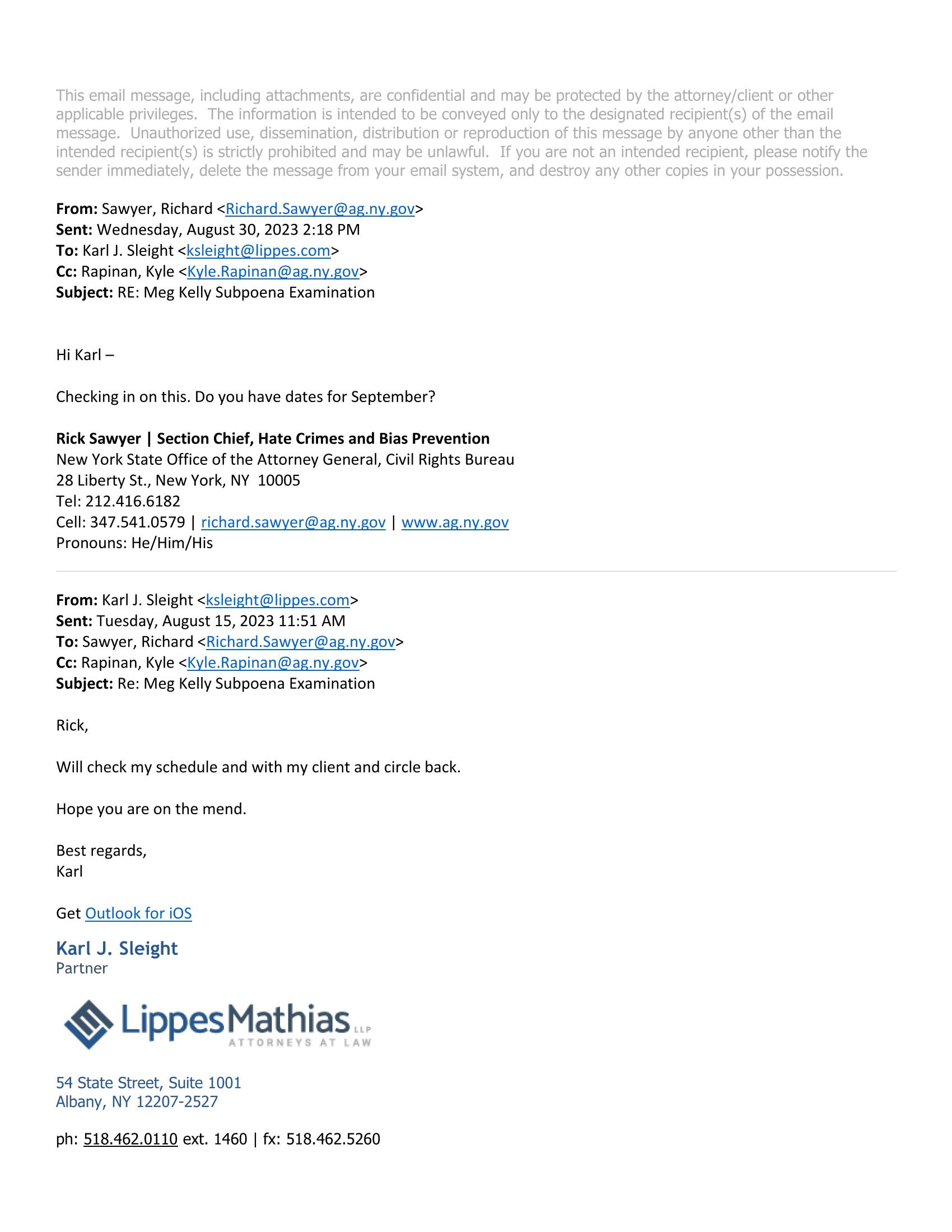
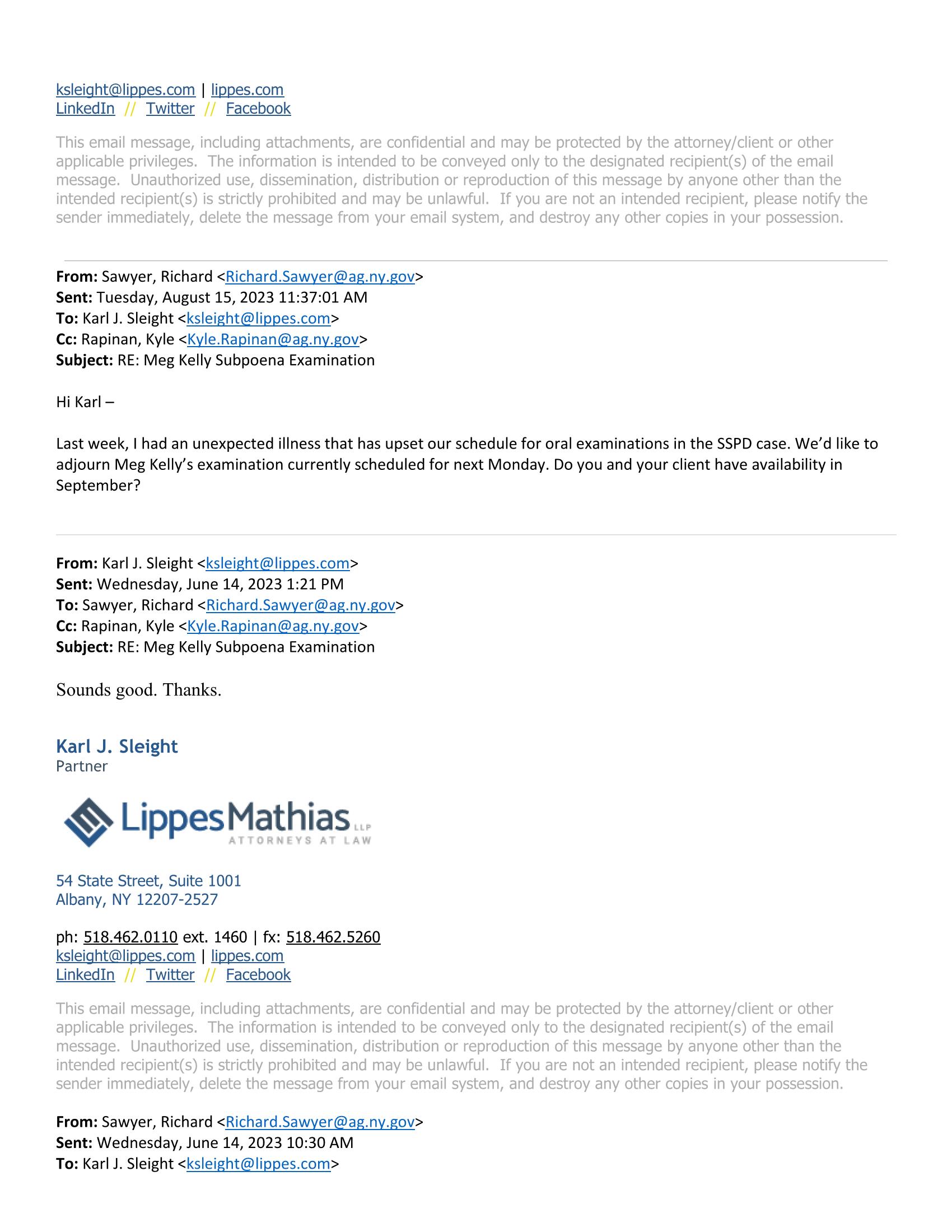
An email exchange between attorney Sleight and Rick Sawyer from the AG’s office is also included at the end of this post. As these documents show, a meeting for Kelly’s deposition was canceled by Sawyer due to health issues. Further efforts were hampered by scheduling conflicts.
The situation became more problematic when Mr. Figuereo initiated a federal lawsuit against the city and a laundry list of people, Ms. Kelly among them.
Attorney Sleight responded to Sawyer, pointing out the legal difficulties represented by dealing with both the AG investigation and the federal suit. Rather than acknowledging this thorny problem and addressing this complication, Sawyer responded imperiously, “This is not a request. (to appear for the deposition)”
If Sawyer seriously wanted to depose Kelly, he could have easily entered a motion in State court to compel the interview. Rather than engage Sleight as courtesy and justice would dictate, he used the issue in an attempt to spin the situation in the report to make it appear that Kelly was uncooperative.
Fundamental Questions Ignored
The AG report could have done a tremendous service if her office had addressed the fundamental questions vexing our city:
What is the appropriate response to people blocking public thoroughfares and demonstrating without permits required by the municipality?
How should the city deal with people who refuse to abide by the Council meeting rules and interfere with the transaction of city business?
The corollary of these two questions is to what extent does the curtailing of this behavior constitute an infringement of the First Amendment?
Nowhere in this report does the AG address these central issues. Instead, every effort, however flawed, by our police and our elected officials to address these issues is deemed to be motivated solely by a desire to limit the freedom of speech of BLM.
A Poorly Researched and Poorly Crafted Report
The thrust of this report was that Saratoga Springs officials and members of the city’s Police Department set out to deliberately suppress the free speech of BLM. This report utterly fails to substantiate this claim. Other than Catone’s remarks, there is nothing in the report that remotely documents any statements to justify this allegation. I invite the readers of this blog to read the report for themselves.
Unfortunately, in the opinion of many, particularly attorneys I have discussed this report with, there is suspicion that this report had less to do with a review of city procedures (most of the recommendations in the report have already been implemented, but the authors of the report didn’t bother to research that either) but more to do with creating a document that could help the pending federal lawsuit against the city by BLM members. Lex Figuereo has already boasted to the press that he is looking forward to the money he and his family will get from the city. The taxpayer dollars that paid for this report from Letitia James’ office have saved BLM some serious change.
I find it interesting that Attorney General Letitia James, who is not afraid of a microphone, has apparently decided to keep a low profile in this matter.
Letter From Meg Kelly’s Attorney Karl Sleight
Emails From Sleight To Sawyer Documenting Subpoena Compliance
On February 29, 2024, at 5:30PM, a ceremony will honor the late Skip Scirocco by naming the Saratoga Music Hall after him. The event will take place at the Music Hall, 474 Broadway.
Skip served as the Commissioner of Public Works from 2008 to the time of his death in 2022.
Skip was a kind and modest man who loved this city.
My fondest memory was his role in blocking what was then called the Saratoga Racino and is now called the Saratoga Casino Hotel from expanding into a Las Vegas-like venue. Then, Mayor Joanne Yepsen resisted taking a stand against the proposal by procrastinating for months from taking a position. Skip finally had had enough and announced his plan to introduce a resolution that would have officially established that our city opposed the expansion. Yepsen was forced to take action and the city resolution effectively killed the proposal.
Skip took this action despite the pushback from the Republican County chair. Skip always put the good of the city before partisanship.
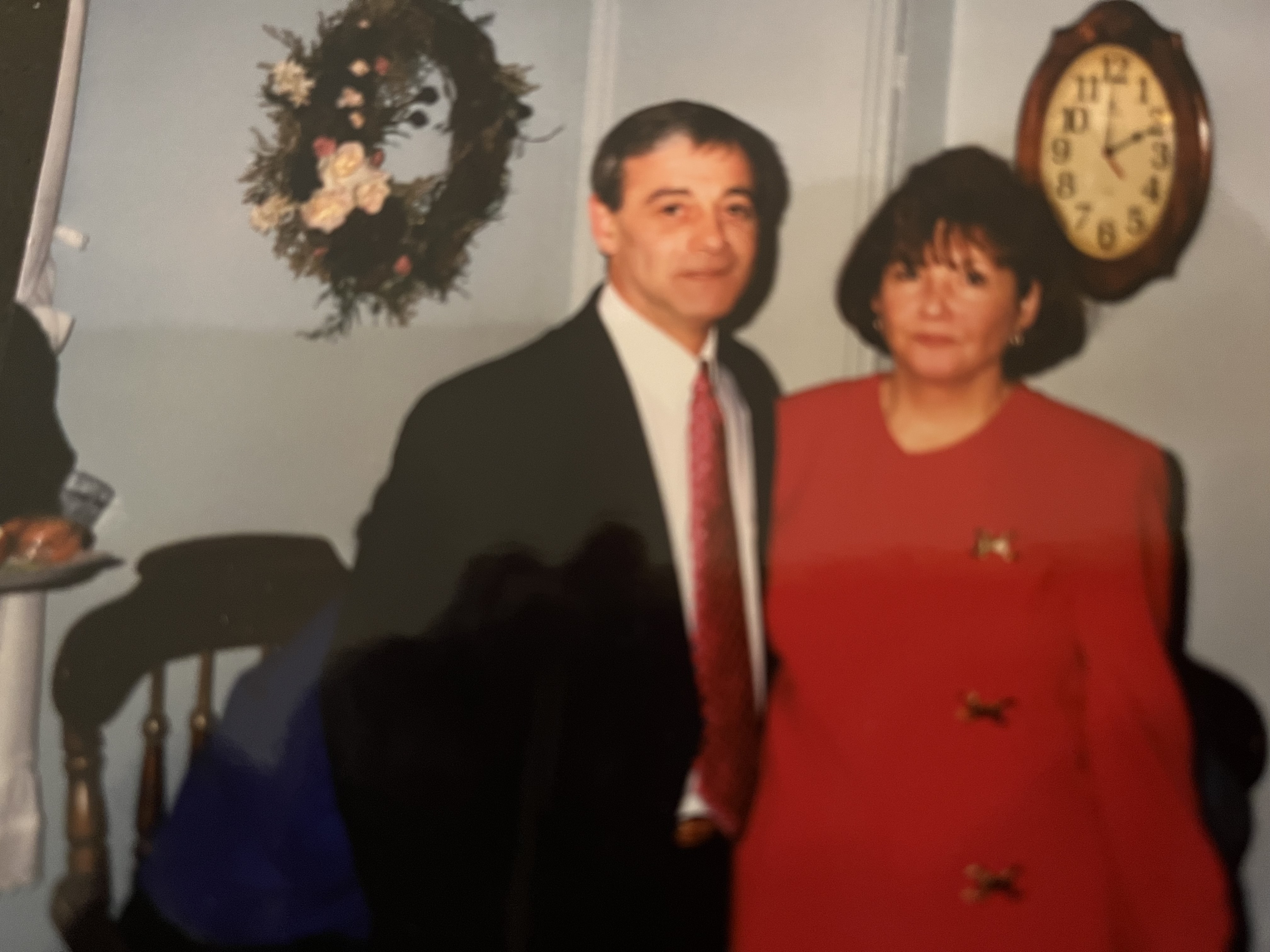
Skip and Corinne
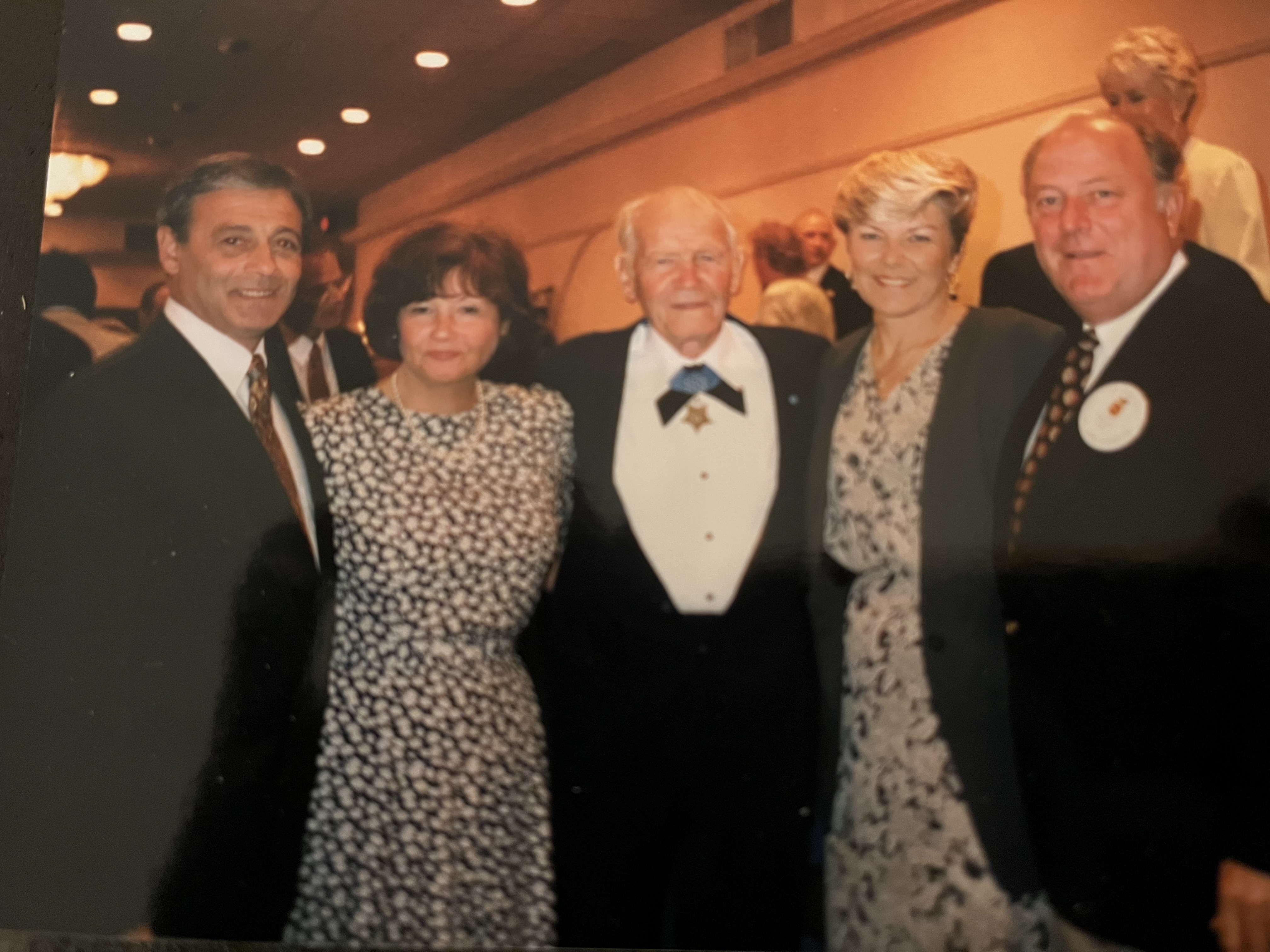
From left to right: Skip, Corinne, John William Finn (recipient of the Medal of Honor), Lynne and Phil Klein
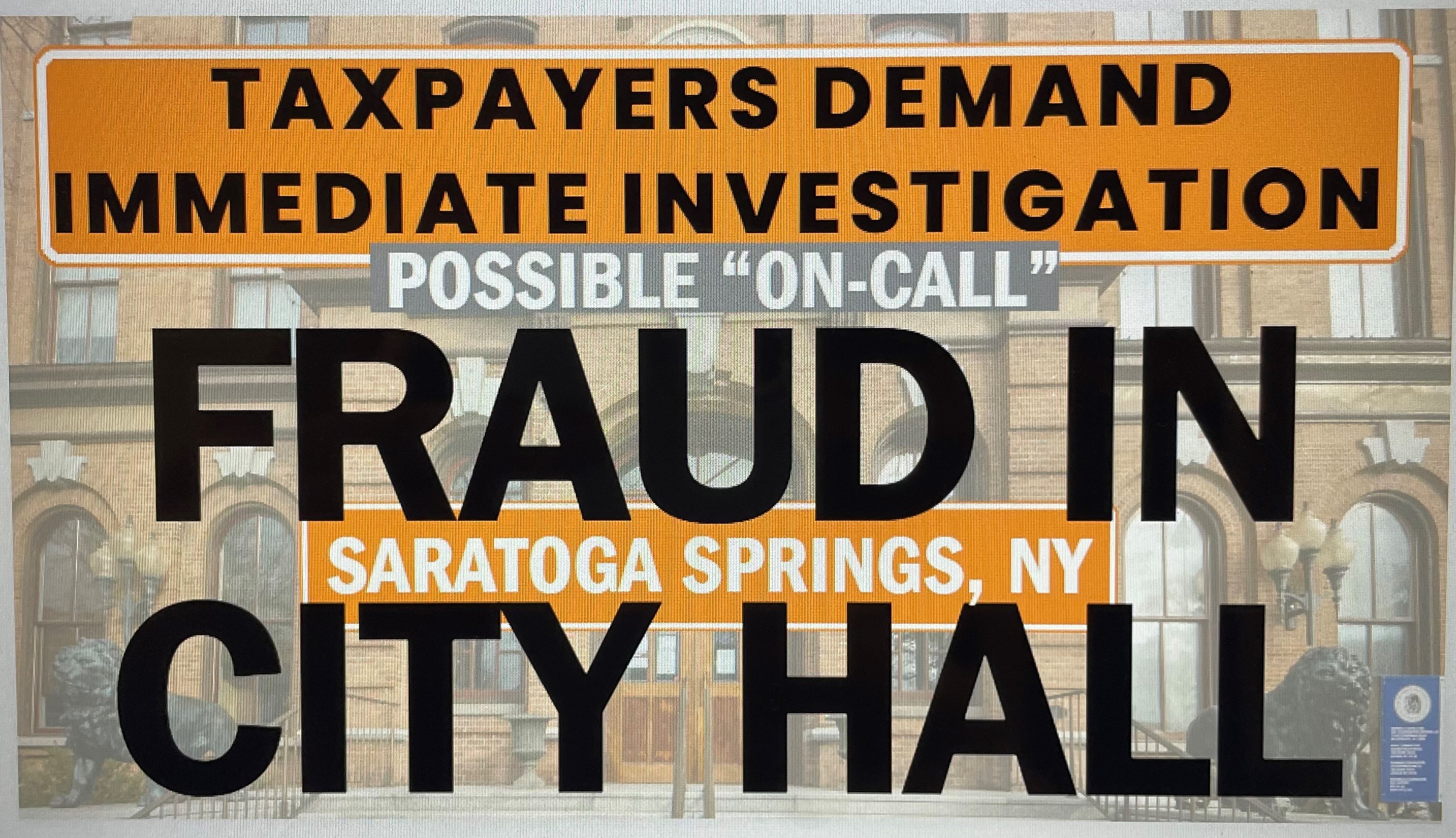
It’s refreshing to see a petition requesting action be taken regarding on-call pay. The petition appears to simply provide background information in a non-accusatory, neutral way and seek support for an impartial investigation in the hopes the results of the investigation will provide the City Council and the taxpayers with a conclusive determination to guide corrective action should that be the determination. The legal opinion rendered by the city’s attorneys contained an easy to follow analysis of the issues regarding on-call pay. The petition is asking city officials to seek the outside opinion of the NYS Comptroller’s office. The results of the Comptroller’s investigation should inform the City Council and provide guidance moving forward. That way taxpayers can be assured the matter is fully concluded by an impartial entity. Plus, it gives city officials an opportunity to be exonerated publicly. This is a good thing.
The petition does the job of encouraging action. It doesn’t necessarily name those potentially responsible or pinpoint the fiduciary responsibilities of our elected officials involved. Readers should agree that a full investigation is warranted when you read that tampering with City documents is defined as a crime in the Saratoga Springs City Code.
The resolution adopted on February 9, 2023 not only dramatically increased the salaries of the Deputy Commissioners and the Deputy Mayor, it added the potential of approximately $6,500 compensation in the form of “on-call pay.” This resolution was fittingly brought forward by Jason Golub, Commissioner of Public Works, because his Deputy, Joe O’Neill, is routinely called to respond to emergencies and coordinate subordinate responses.
The Code of the City of Saratoga Springs says Tampering with Documents is a Crime
Any person who, without authorization from the City Clerk, changes or amends, by additions or deletions, any part or portion of the Code of the City of Saratoga Springs or who alters or tampers with such Code in any manner whatsoever which will cause the legislation of the City of Saratoga Springs to be misrepresented thereby or who violates any other provision of this local law shall be guilty of an offense and shall, upon conviction thereof, be subject to a fine of not more than $250 or imprisonment for a term of not more than 15 days, or both.
In compiling and preparing the local laws, ordinances and resolutions for publication as the Code of the City of Saratoga Springs, no changes in the meaning or intent of such local laws, ordinances and resolutions have been made, except as provided for in Subsection B hereof. In addition, certain grammatical changes and other minor nonsubstantive changes were made in one or more of said pieces of legislation. It is the intention of the City Council that all such changes be adopted as part of the Code as if the local laws, ordinances and resolutions had been previously formally amended to read as such.
Dillon Moran, Custodian of All City Documents; Including Altered Resolutions
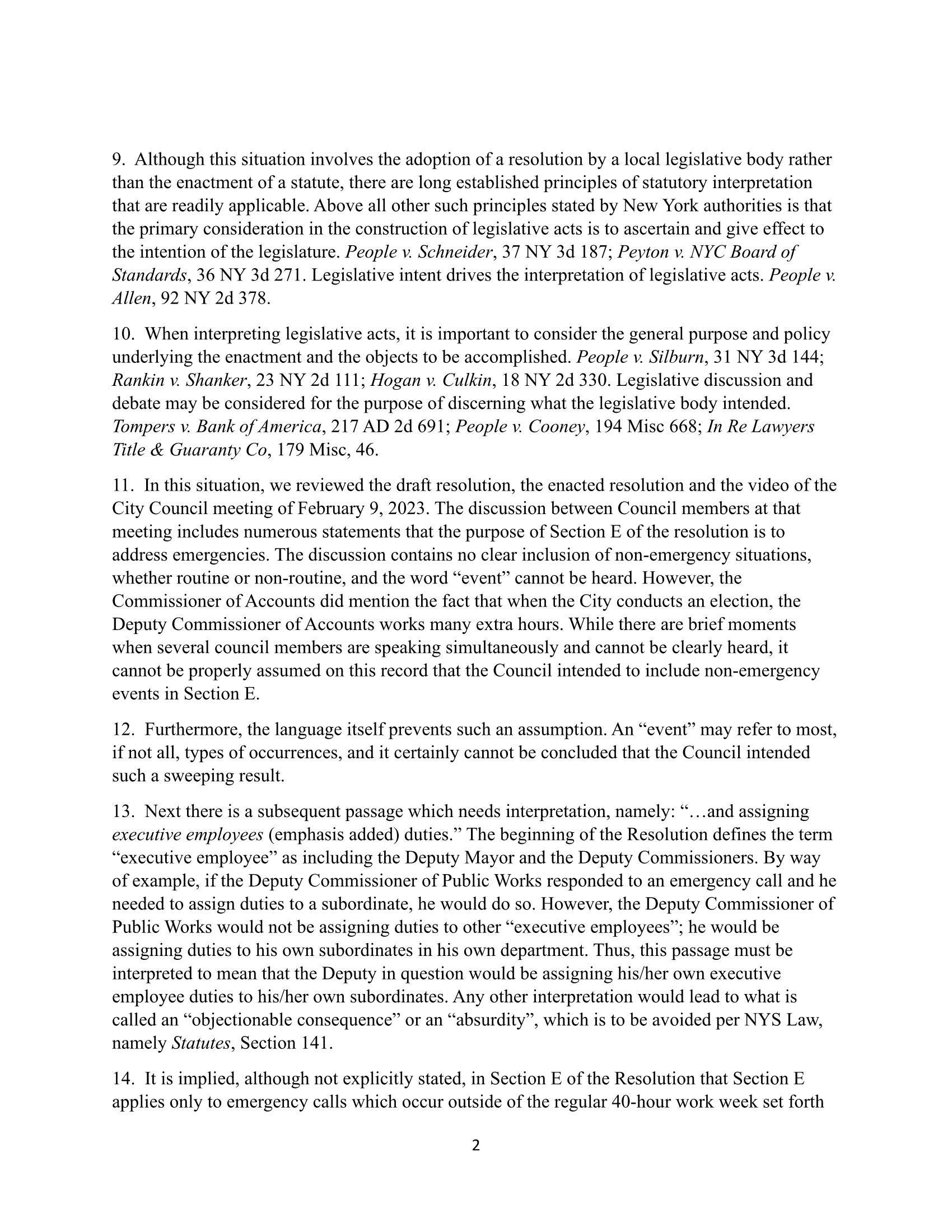
Foiled documents provide metadata suggesting Stacy Connors, Dillon Moran’s Deputy Commissioner of Accounts, edited the final resolution on February 14, 2023, the week following the City Council meeting. That final resolution added the words situations and events which were not included in the adopted resolution. Was the language added so Deputies in departments which do not respond to emergencies could collect on-call pay? Per the City Charter, the Commissioner of Accounts serves as City Clerk and is the custodian of record for all City documents. This is quite worrisome as the altering of this document occurred in Moran’s Department.
City Charter Title 7.1.2 City Records- The City Clerk shall receive, file, index, and archive, as custodian of record of all City documents, records and other instruments required by law to be filed and maintained by the City.”
An Emergency to Me May not be an Emergency to You
At the February 5, 2024 City Council pre-agenda meeting the legal opinion was presented. Commissioner’s Moran and Sanghvi rejected the legal opinion in part or in whole. Does that mean they still support the altered resolution? Moran stated, ”We can define emergencies in different ways. An emergency to me may not be an emergency to you.” Since the discussion is focused around a legal document it might make sense to use a legal definition of an emergency.
Cornell Law School posts the following, “An emergency is an urgent, sudden, and serious event or an unforeseen change in circumstances that necessitates immediate action to remedy harm or avert imminent danger to life, health, or property; an exigency.”
Black’s Law Dictionary 2nd Edition defines an emergency as, “Situation requiring immediate attention and remedial action. Involves injury, loss of life, damage to the property, or catastrophic interference with the normal activities. A sudden, unexpected, or impending situation.”
Win-Win for Moran
Commissioner Moran was very adamant that the legal opinion was incomplete. He complained that he was never consulted during the analysis of evidence on which the legal opinion is based. He suggested an outside opinion be sought. It’s likely that during an investigation by the Comptroller’s office Commissioner Moran would have plenty of time to give his input as this outside opinion is rendered. It sounds like a win-win for Commissioner Moran.
Commissioner of Finance Looks the Other Way?
Taxpayers should also understand the ultimate guardian of City funds is the Commissioner of Finance, Minita Sanghvi. “The Commissioner of Finance is the chief fiscal officer of the City and shall certify payrolls.” (City Charter Title 4)
The very last line of the resolution reads, “J. This resolution may be reviewed and brought forward by the Commissioner of Finance for future adjustments.” Commissioner Sanghvi, upon the first submission for on-call pay, should have brought her concerns to the City Council. The justifications listed on the on-call pay sheets were not congruent with the resolution adopted citing emergencies not situations and events. Instead, Sanghvi continued to sign off on all on-call payroll submissions including those of her own Deputy. The end of the first quarter of 2024 is March 31st. Based on past practices and the verbiage of the still uncorrected resolution, there is potential that Commissioner Sanghvi could approve over $8,000 in on-call payroll submissions.
This is not a good look for Sanghvi, who is also currently running for a State Senate seat. If Commissioner Sanghvi is found culpable in this matter, one might think this could seriously impact her campaign.
Sanghvi Funds Only Public Works On-Call Pay in 2024 Budget
Based on the language of the adopted resolution, discussions at the February 9, 2023 meeting and the legal opinion, it is clear the intention of the resolution was to compensate the Deputy Commissioner of Public Works. What has not been exposed is that the adopted 2024 City budget, prepared by Commissioner Sanghvi, includes the familiar Deputy allotted amount of $6,500 budgeted for on-call for Public Works and only Public Works. Finance and Public Safety do not include an on-call pay line item. The Accounts’ and Mayor’s departments list an on-call line item which Commissioner Sanghvi did not fund.
Saratoga Springs City Attorneys David Harper and Tony Izzo issued an opinion regarding the resolution that established the city’s on-call pay policy for Deputies. At the pre-agenda meeting February 5, Accounts Commissioner Dillon Moran contemptuously dismissed the opinion with extensive, rambling, and caustic declarations. Finance Commissioner Minita Sanghvi was also critical.
The Opinion
The City Attorneys’ legal opinion was carefully researched and crafted (it can be found at the bottom of this post). Impressively, unlike some legal opinions, this one is easily understood by non-attorneys.
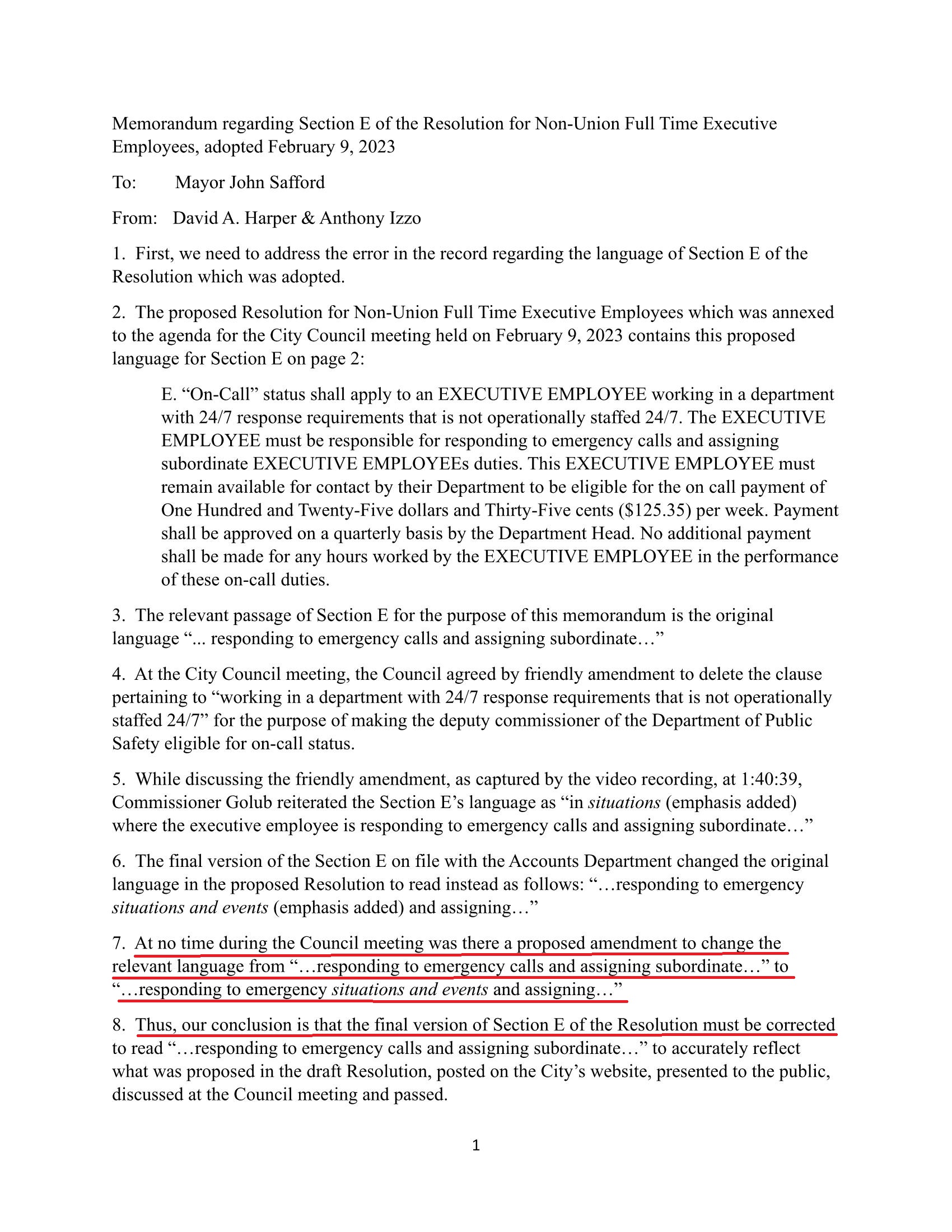
After considerable controversy arose over the collection of on-call pay by four of the five Deputies in 2023, Mayor Safford asked the City Attorneys to advise the Council on who, if any, of the city’s Deputies was eligible for on-call bonus pay according to the resolution passed by the last Council in February of 2023. He also noted that there was a conflict between the apparent record, as documented by the minutes and the video of the meeting, and the version posted by the Accounts Department. The Mayor asked the Attorneys to clarify what the resolution actually stated.
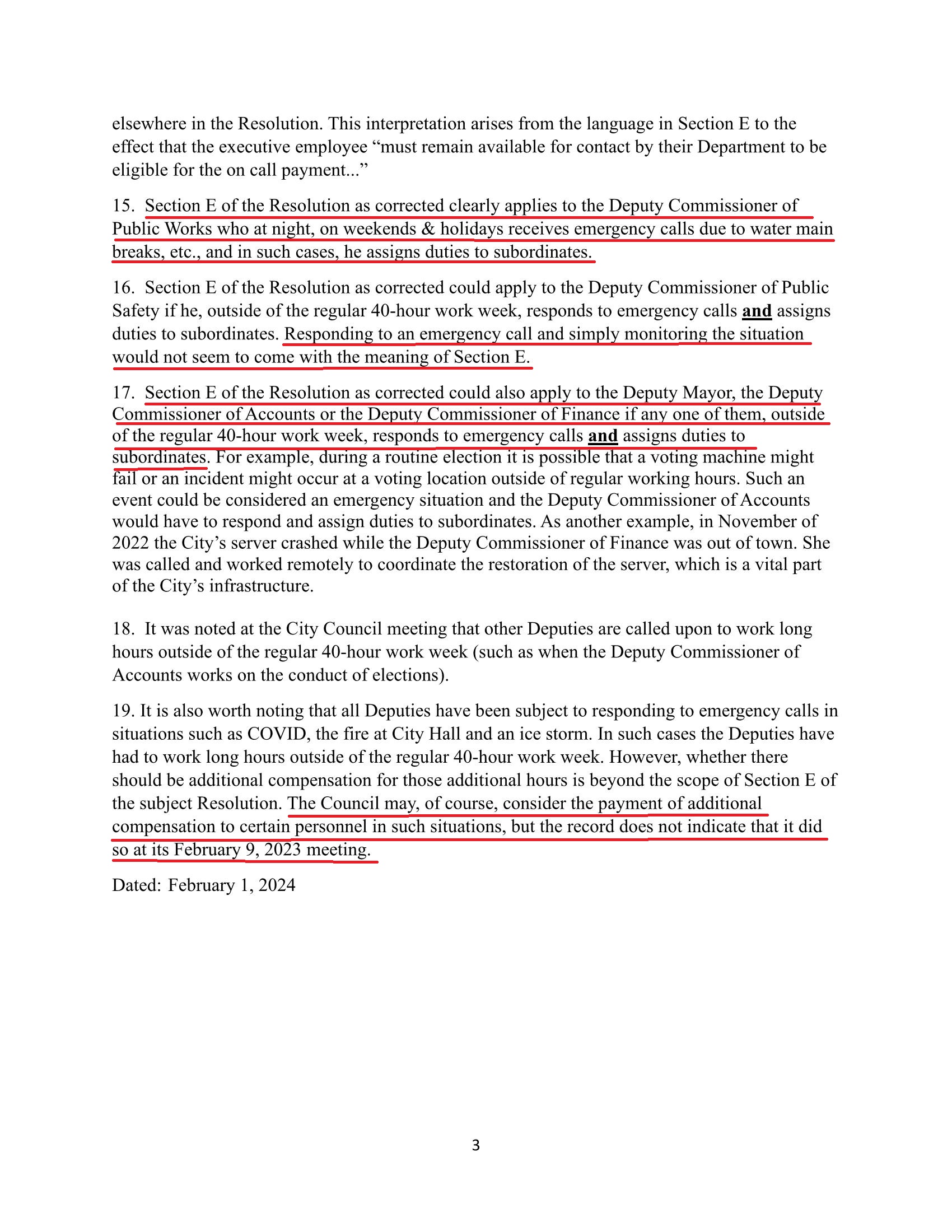
In the case of the Deputies, the Attorneys found that the text of the resolution “clearly applies to the Deputy Commissioner of Public Works who at night, on weekends & holidays receives emergency calls due to water main breaks, etc. and in such cases, he assigns duties to subordinates.”
The opinion acknowledges that, as the Accounts Department is responsible for supervising local elections, there is a brief period of time during elections when the Accounts Department Deputy might need to be on call.
Apparently, at Commissioner Sanghvi’s request, the opinion included that in November of 2022, the Finance Department Deputy was contacted outside of regular hours when the city server was down.
Improperly Paid
The implications of this opinion are significant. The Deputies for the Mayor, the Commissioner of Accounts, and the Commissioner of Finance submitted invoices for approximately $10,000.00 for which they were not eligible. Adding to this fiasco’s significance was that in all three cases, their respective bosses all signed off on these invoices.
It also reflects a breakdown in the oversight by the Finance Department, which should have flagged these invoices but did not. Indeed Finance Commissioner Sanghvi herself signed off on her own Deputy’s inappropriate request for payment.
The Pre-Agenda Meeting
At the February 5, 2024, Council’s pre-agenda meeting, Mayor John Safford introduced a discussion regarding the legal opinion on on-call pay. He did not seek to claw back the sums of money that should not have been paid to the deputies. He had apparently hoped his colleagues would simply abide by the City Attorneys’ legal opinion, making a contentious discussion unnecessary. His hope was not realized.
Moran’s Bullying
Dillon Moran knew he had a problem well before the City Attorneys issued their opinion. Some weeks earlier, Moran approached Department of Public Works Deputy Joe O’Neil with a proposal. He asked O’Neil to support a plan that would eliminate on-call pay and instead pay all the deputies an additional $5,000.00. It is important to note that Deputies had already received a substantial salary increase in the same resolution that contained the on-call provision.
Moran clearly knew that his Deputy was not eligible for on-call pay and that he himself was implicated in inappropriately paying her because he signed the form that authorized the payments to her.
If the Council expunged on-call, it would imply that the whole thing had been a mistake for which everyone was culpable aka “mistakes were made.”
He received no support from DPW, and his idea went nowhere.
Carl Sandburg famously opined:
“If the facts are against you, argue the law. If the law is against you, argue the facts. If the law and the facts are against you, pound the table and yell like hell”
Carl Sandburg
At the pre-agenda meeting, Moran took Sandburg’s advice to heart.
Moran’s problem was that the opinion on on-call was sufficiently compelling, defying any arguments that Moran might put forward based on the actual opinion in the text. Undaunted, Moran threw out every imaginable buzzword and sound bite for twenty minutes, denouncing the decision without addressing its substance.
He asserted that he had been blindsided by the opinion. At one point, he asked his colleagues to raise their hands if they had not had an opportunity to discuss this opinion with the City Attorney. This did not work well for him as he was the only one who raised his hand. In fact, he had had plenty of time to read the opinion and to seek out the City Attorney to discuss any issues or questions he had.
Moran threw out every possible cliche and catchword in his ramblings, hoping he would bully Mayor Safford and undermine the integrity of the opinion. Conspicuously missing was any discussion of the actual substance of the opinion’s text.
Here is a thirteen-minute video of the event. For those who do not want to endure the video, I offer highlights of what Moran said. Readers will note that conspicuously absent from Moran’s objections was any discussion of what the resolution actually said.
He claimed the opinion was somehow prejudicial against the employees in his department.
He asserted that “The context of the charter is not considered here.”[JK. What’s the charter got to do with this?]
He asserted that “The context of the appointing authority is not here [JK: appointing authority?]
He asked “How do you know the legislative intent if you weren’t in conversation with the people who were actually in the conversations?” [JK: the opinion was co-authored by Tony Izzo who has been with the city for over 35 years and Jason Golub, the author of the resolution, spoke extensively with the two attorneys.]
Referring to the opinion, he said he would “love one that was well informed. This wasn’t a well informed opinion.”
“I understand, as the appointing authority, what my responsibilities are to make priorities within my department. None of that’s in here.”
“I reject this [JK: The opinion]”
“I suggest this is a flawed process, and if we are going to work together, this isn’t how you do this.”
“It’s an unnecessary witch hunt.”
“So we are going to make a decision without proper consideration about all the elements.”
“This does nothing.”
“What’s germain is that it was not properly recorded. It was not reflected in the minutes the way it was supposed to be. It was not put forward as an action of the city council the way it was supposed to be. That’s the responsibility of this body.” [JK: Try to figure out what that is supposed to mean]
“Everything is essential. If the people who work inside the building don’t put in the extra hours to get things done, the government stops working. This agenda process completely stops. We did a tremendous amount of work on the processing and the work and the transactional requirements for station three. That doesn’t happen without my department working with Chief Dyer extra long hours. Well listen, it’s not in the context of a conversation because we weren’t brought into it.”
“It’s (the opinion) is on the agenda and I didn’t get a chance to look at it. What’s the rush?” [JK: The agenda with the opinion was posted on the city website]
“What’s the rush? What’s the rush? What’s wrong with having the conversation about what’s important in my department? I don’t think he (David Harper), in the three weeks he has been here [JK: The opinion was signed by both Harper and Tony Izzo. Tony has worked for the city for over thirty-five years], knows anything about the importance of what happens in my department, the priorities I have set within the community. We can define emergencies in different ways. An emergency to me may not be an emergency to you.”
“It’s not perfect, but if it applies to one, it applies to all.” [JK: The whole point of the opinion is that there is a criteria as to who is eligible so on-call does not apply to all]
“I would suggest we have conversations internally to address this and not air it out, halfway done.”
“I don’t see the value of having this conversation when its incomplete. At least two people sitting at the table are not happy with how are departments are reflective. I don’t understand what you are trying to accomplish with this.”
“This seems like a flogging. You’re setting up more people to take body blows over something that has nothing to do with them.”
“I’m not happy about the way people have been treated.”
“Intent and outcome. The outcome is what matters.”
Interrupting Mayor Safford referencing the legal opinion, “It’s an incomplete one at best.”
“I didn’t know this was going on the agenda. It was presented to me the day after the agenda came out, so that’s the problem.”
“I want to understand what the end goal of this is. It doesn’t seem it is a thorough, comprehensive understanding of the circumstances. It seems like…I don’t know. Like I don’t know. Kick the can down the street? I don’t know. I don’t see any value in this conversation about a half-written document that half of us don’t agree to.”
“We haven’t gotten to that point yet. I would say that’s a good starting point. Have everyone have the opportunity to talk about this before it goes out into the public.”
“I disagree with the process. If I’m not allowed to even speak to an issue that I’m being talked about in. People are talking about my intent. I have a problem with that. as anybody would.”
“I don’t even know what’s the intent.”
“We do things for a reason, right? A plus B equals C. We already have a C. This document that has been thrown out into the public that doesn’t accurately reflect the circumstances of this issue. It was a year-long negotiation. I was in the room almost every single time. The idea I wouldn’t be talked to is absurd to me.”
Commissioner Golub offered the most thoughtful response to Moran. He tried to get Moran to focus on what the opinion actually said rather than what Moran wanted it to say.
Minita Sanghvi’s Push Back
Commissioner Sanghvi argued that the IT department was a “critical infrastructure.” She observed that the IT department had to function 24/7 and that her deputy would need to be on-call in case of a problem outside of business hours.
The opinion acknowledged that IT was indeed critical infrastructure. In addition, Harper and Izzo added language to the opinion, presumably at Sanghvi’s request, that in November of 2022, “the server crashed while the Deputy Commissioner of Finance was out of town. She (the deputy) was called and worked remotely to coordinate the restoration of the server, which is a vital part of the City’s infrastructure.”
Strikingly absent from Sanghvi’s remarks was that the city has had on-call support for IT for over a decade. The city has an agreement with the union that three IT staff rotate being on-call and are paid for it, although less than the amount the Deputies collected for their alleged on-call time. This organizational structure has served the city well.
As a person who made a career as a programmer, I find Sanghvi’s remarks very strange. As far as I know, Sanghvi’s deputy does not have a technical background in IT, and it is reasonable to assume that she would be of little assistance in the event of a server crash or in the installation of software at night.
I contacted Mike Sharp, who was the Deputy under Finance Commissioner Michele Madigan. He offered the following:
Hi John,
Hope you’re having a great trip. IT’s “on call” language is in the CSEA contract (which they are a member of) I believe, and may also be referenced in the city’s Emergency Plan. The language for how and when they are “on call” is explicitly laid out, since it is additional pay. A finance deputy being “on call” for IT is nonsensical. They are not a trained IT expert, and while technically they are second in command for the office, they don’t (or shouldn’t) manage the specific workload of their employees, the same way the DPS deputy isn’t asked to opine on every call made into the fire and police departments. The IT head giving updates to the deputy, who isn’t doing anything other than communicating with their boss and maybe other deputies, is not something that should warrant them being paid extra.
– Mike
Being Firm Is Not Being Uncivil
I think it is laudable that Mayor Safford was patient and thoughtful in spite of Moran’s incendiary attacks on the legal opinion and its authors, David Harper and Tony Izzo.
In the end, I expect Mayor Safford to be respectful but firm with Moran and Sanghvi that the opinion is clear and that they will need to adhere to it.










 Saratoga Springs Politics