At the special end-of-year Saratoga Springs City Council meeting on December 28, the Council’s deliberations were marked as usual with improper proposals, confusion over resolutions, and, of course, acrimony.
Finance Commissioner Minita Sanghvi’s agenda included a proposal to fix what she referred to as the “human error” in the 2024 city budget that resulted in her budget improperly exceeding the New York State Property Tax Cap. Apparently, a miscalculation having to do with a program called “payment in lieu of taxes” (PILOT) was the cause of the problem. The Commissioner did not explain how the error occurred or why she had just noticed that her budget violated the state’s tax cap (this blog indicated the tax cap was an issue weeks ago) and how she planned to avoid such events in the future.
The remedy Sanghvi proposed involved the Council approving changes in the 2024 budget. Kim repeatedly and forcefully stated that amending the 2024 budget in 2023 was in violation of the city charter and that he was “aghast” that she was proposing this.
In the end, no action was taken, and the problem was kicked over to the incoming Council.
At the same meeting, Accounts Commissioner Dillon Moran offered a resolution to award a bid to a company for, as far as I can tell, setting up a registry for short-term rentals in the city.
Moran acknowledged that his resolution did not include an actual contract with the firm as was usually the case. He told his colleagues that changes in the insurance market had become a barrier to the city’s standard contract. He assured his colleagues he would work things out and that a contract would be ready for action at the next Council meeting. He told his colleagues that rather than use the city’s contract, he would use one from the vendor. This vendor had, apparently, already gotten the city to sign a non-city contract with the firm previously.
The city purchasing policy restricts the use of non-city contracts. Such contracts are only to be used in unusual circumstances and, most importantly, must include all the city’s requirements.
The normal procedure would have been for Moran to present all the items related to an award bundled together for action. These would have included the contract.
Why Moran could not wait until he had all the documents ready to present this to the Council is unclear, but this is part of an unfortunate pattern. There is, of course, the possibility that the successful bidder could not comply with the city’s policies, so prudence would have had Moran wait on the matter.
This is especially odd because he was introducing his resolution at a special meeting of the Council on December 28, and the new Council would be meeting in only five days. He never explained why there was a rush on the matter nor why he felt the need to bifurcate the process over two meetings.
In fact, the agenda for January 2, 2024, is on the city’s website, and there is no item on his agenda for this proposed agreement.
Pardon the play on words of the title of this post, but hopefully, this new council will combine the fact that it is a new order (group) and hopefully will bring a new discipline (order) in how this city does business.
As far back as I can remember, previous Councils have utilized their City Attorneys to review resolutions to be brought before the Council first to ensure that they met all the legal requirements both of our own charter and of all related other institutions.
Hopefully, on January 2, 2023, when the new Council convenes, Moran’s proposed contract will be tabled if it appears on his agenda and, along with the documents he presented on the 28th, they will be reviewed by the new City Attorney before any further action is taken.
In fact, I am optimistic that the free-for-all of chaotic resolutions submitted, withdrawn, resubmitted, etc., will be history, and the new Council will move forward with a more disciplined and deliberative approach to legislation, and it will indeed be a Happy New Year for the city.
Some years ago, New York State adopted a tax cap for municipalities and school districts. It required that these institutions limit their tax levy increase to 2% or inflation, whichever is lower. In the case of municipalities, they can override the tax cap, but there are strict rules on how this is to be done. Saratoga Springs Commissioner Minita Sanghvi’s 2024 budget adopted by the Council, Sanghvi now admits, exceeded the state’s tax cap without adhering to state requirements.
On December 7, 2023, I published a post on the chaos of the proposed city 2024 budget. At the time, I wrote:
This budget, however, which raises taxes for the second year in a row, appears to have a tax levy that exceeds the New York State limit.
December 7, 2023 blog post
Finance Commissioner Minita Sanghvi has proudly announced on several occasions that she does not read this blog. It appears that in this case she might have benefited from doing so. It seems that she has just discovered at the last possible moment that, in fact, the city has exceeded the tax cap and did so without first passing a required local law that would allow for this.
Here is an excerpt from her resolution:
“WHEREAS, since then, it has come to the attention of the Department of Finance that the amount stated in the 2024 Adopted Budget as $17,640,999, which is listed as line # A012-41001 was based on erroneous calculations. Upon investigation, it was found that the calculations were caused entirely by human error. A summary of the erroneous calculation and the correct calculation are included with this resolution and made a part hereof”
Resolution From Commissioner Sanghvi
As Sanghvi routinely touts her transparency, it will be interesting to see if the public will learn exactly what the error was, who was responsible for it, and what actions will be taken to avoid such errors in the future.
Cap Guidelines from the New York State Department of Taxation and Finance and the New York State Department of State gives these directions:
“If the levy exceeds the tax levy limit due to technical or clerical errors, the excess amount shall be placed in reserve in accordance with Office of the State Comptroller requirements.”
For some reason Commissioner Sanghvi, having now admitted her budget exceeded the tax cap is now ignoring the state’s direction on what the next step needs to be.
Instead she has on her agenda a resolution that takes a convoluted path to amend the 2024 budget and amend the tax rate based on section 4.4.8 of the city charter.
My reading of the state requirements for overriding a tax cap lead me to believe that Sanghvi’s resolution fails to adhere to the state’s requirements. It is unclear if Sanghvi has communicated with the Comptroller’s office as to whether her resolution is acceptable.
As the current people on the Council routinely introduce new resolutions at the Council table, I am going to wait until the final version is adopted to comment further on whether they are handling the override properly.
The December 19, 2023, Saratoga Springs City Council meeting was another five-hour meeting where the requirements for legislation were ignored and where misinformation was shamelessly spread.
Here is an account of some of the actions, or inactions, that evening.
Promises, What Promises?
At the previous Council meeting, Accounts Commissioner Dillon Moran tried to pass a resolution placing himself in charge of overseeing a contract to audit the the city’s 50 point plan put together by the Saratoga Springs Police Reform Task Force. It was an obvious stretch to have him, rather than the Public Safety Commissioner, supervise the audit. Moran withdrew the resolution, telling his colleagues it would be more appropriate to have incoming Public Safety Commissioner Tim Coll and Public Works Commissioner Jason Golub, who had co-chaired the Task Force, in charge.
Apparently, he either changed his mind or forgot about his promise. The resolution that was actually adopted by the Council on December 19th was the same one Moran had withdrawn at the previous meeting. None of his colleagues on the Council acknowledged his decision to renege, let alone offered any challenge, including Commissioner Golub, who was present at the Council table. Did no one else on the Council bother to read the resolution, or did no one on the Council care? Who knows?
Making A Mockery Of Transparency
Mayor Ron Kim issued a memo at the meeting on the pending release of the New York State Attorney General’s investigation into allegations against the city for its treatment of Black Lives Matter activists. Kim had already taken his memo to every media outlet in the capital district and gotten plenty of coverage.
Congratulating himself on his alleged transparency, he claimed he was issuing his statement out of a commitment to transparency even though he admitted he had not actually seen the Attorney General’s report which has not yet been released. His document was full of hearsay conjectures based on discussions he had had with the AG office during the investigation.
Apparently, the Attorney General was not pleased that Kim did this. In a tersely worded release, the Attorney General’s office wrote:
“We are disappointed that details from private and preliminary settlement conversations were shared without our knowledge or approval.”
Office of the New York State Attorney General
Kim’s $13,250.00 Error
Every opportunity Mayor Kim finds to remind Saratoga Springs citizens of the cost of providing legal assistance for officials and employees swept up in the Attorney General’s investigation, he recites the names and amounts.
In the same release that speculated on the Attorney General’s impending report, he again listed the officials and their bills.
In the case of former Public Safety Commissioner Robin Dalton, he stated that the city had paid $29,000.00.
How Kim arrived at that figure is unknown. The actual bill was for $15, 775.00.
At the meeting, Robin Dalton advised the Mayor of his error during the public comment period. Did he apologize? No. He sat grim-faced.
The following is an email from Ms. Dalton’s attorney that indicates he has never spoken to Mayor Kim and had only one brief contact with City Attorney Tony Izzo, during which he indicated the initial estimated cost, which was not $29,000.00. The following is an email documenting this.
From: Michael P. McDermott, Esq. Date: Thu, Dec 21, 2023 at 1:17?PM Subject: Dalton legal expenses To: jcatkids@gmail.com CC: Meghan E. Hebert
Dear Ms. Dalton,
I am writing in response to your request for a breakdown of the legal fees paid to date on your behalf by the City of Saratoga Springs.
Initially, I note that the only person I discussed potential fees with was Mr. Tony Izzo. I enclose our letter to Mr. Izzo dated February 1, 2023 wherein I gave an initial estimate of $10,000.00 as the cost to respond to the Attorney General’s subpoena. I have never discussed your case, nor offered an estimate of future legal expenses, with Mayor Kim.
To date, the city has been billed, and paid our firm, the sum of $15,755.00 for your defense. That sum represents $6,990.00 in attorney time and $8,765.00 in disbursements associated with the data harvesting of your phone, which we paid on your behalf to Capital Investigations Group. Copies of the relevant documents are attached for your reference.
If you have any other questions regarding this matter, please feel free to contact me.
Best regards, Mike
Michael P. McDermott, Esq. President and Shareholder
Dillon Moran and His Colleagues on the Council: City Procedures and Policies? Who Cares?
The city has a rigorous set of procedures that were established by Marilyn Rivers during her tenure as the Director of Risk and Safety to ensure that in awarding contracts, the city is protected from any mishandling that might create problems in the future. They can be cumbersome, but their rigorous enforcement is part of the reason the city has enjoyed one of the highest bond ratings in New York State.
At the pre-agenda meeting on Friday, December 15,2023, Dillon Moran offered the following:
“We are transitioning the Risk and Safety approvals. We uncovered a spot where I wasn’t seeing certain documents [JK: What ever that means.] I’m working through all those approvals today for the outstanding contracts. What we had is them essentially move forward contingent on my approval. Those will all be resolved before the end of the day [JK: That day being Friday, December 15. Even if he did not meet his goal of properly updating the information that day, he still had four days to complete his work.]
Dillon Moran December 15, 2023
On Moran’s agenda for the December 19th Council meeting was an item to approve a contract with Beacon Risk Group to audit the city’s progress in implementing the Police Reform Task Force’s fifty-point “Reinvention Plan” that had been adopted by the previous Council in 2021.
Beacon Risk had been selected last June to do the audit. The problem was that as of the Tuesday evening Council meeting, the insurance certification document posted with the Beacon Risk Group (BRG) resolution still did not include all the coverage required by the city, including the mandated umbrella policy, the auto insurance policy, and workman’s comp insurance or a state waiver that would relieve BRG of this requirement.
I attended the Council meeting to point out that the insurance document on the city’s agenda for BRG, which Moran was asking the Council to adopt, did not meet the city’s requirements.
There was no reason why Moran could not wait to ask for Council approval until he could present to them and to the public a properly documented award. After all, BRG had been selected some six months earlier, so no one seemed in a hurry to get this done.
Why Moran was suddenly in a feverish rush to get this contract approved when the Council had a special meeting scheduled for December 28, 2023, is anyone’s guess. This was not the only resolution he was insisting be adopted in violation of the city’s purchasing policies.
This is a video of your blogger making these points to an indifferent Council.
During his agenda, Moran assured his colleagues that he had in his possession a proper insurance certification form from BRG. Moran did not bother to disclose why he did not properly post this alleged correct document with the resolution. Nor did Moran explain why he could not wait until the proper documents could be posted to ask for a vote. It is, of course, possible that Moran does not have the actual proper insurance certification.
None of this seemed to bother a pliant Council, which unanimously approved the BRG resolution.
This is a clip from later on in the meeting on a different subject, but it really says it all. Moran publically proclaims that the Council routinely violates city policies and procedures. Be assured this is not taken out of context.
Duplicative Contracts, Who Cares
Last May, the Council approved a resolution to establish a Restorative Justice Panel. Their mission was to “seek to define via community input and dialogue a ‘Saratoga Springs’ Restorative Justice Program.” While I appreciate the dedication of the members of the Restorative Justice Panel, their meetings have been unfocused and marked by confusion.
Due to their inability to come up with a concrete strategy, they resorted to recommending two actions. Hire a consultant and do a survey. This is the common outcome committees resort to when they are lost.
The process, engineered by Deputy Mayor Angella Rella, was to exploit the poorly worded city policy regarding the purchasing of professional services in order to rush funding through to hire a consultant using a Request for Quotes (RFQ) instead of the more appropriate Request for Proposal (RFP) procedure.
There are two vehicles for contracting professional and other services and goods.
Request For Quotes (RFQ)
Request For Proposals (RFP)
Request for quotes are supposed to be used when the item(s) being sought are defined clearly enough that all the bidders have to do, as the word “quote” signifies, is to submit an amount. RFQs are most often used by the Department of Public Works. So DPW might put out an RFQ for one hundred shovels or for a Ford 150 two-door pickup truck.
An RFP is used when the city has a problem they want solved. They might put out an RFP for a homeless shelter. Here, the competitors would have to come up with proposed designs and their costs.
The award process for RFPs is highly structured. The city must establish a set of criteria by which to compare the proposals. Contacts between the bidders and the city are supposed to be rigorously enforced. The answer to any question asked by a bidder must be shared with all the other competitors.
In the case of this RFQ put together by Rella, the words informal and unstructured come to mind. There is a catch in the purchasing procedures. RFQs are allowed for any purchase under $30,000.00. So this group, supported by the City Attorney, claims that even though the Restorative Justice Committee was soliciting proposals rather than just quotes, they could do so. In so doing, they were able to ignore all the requirements for establishing a transparent and structured process by which to compare the proposals.
If this all seems confusing, it is, but it reflects an indifference to the need to use a professional method to compare the proposals in a manner that is fair to the bidders and that will result in an effective use of city money.
The winning “quote” included the following statement:
“In light of the questions and concerns regarding the fidelity of the implementation plan to-date, we will work collaboratively with the Reinvention Plan Implementation Team to design and publish a public and frequently updated ‘Report Card’ detailing actual numerical and qualitative progress in implementing with fidelity, each of the fifty points”
Fenton-Ives successful proposal for restorative justice
As Jane Weihe pointed out to the Council, this is a clear duplication of the audit that Beacon Risk Group is being contracted to do.
Again, there was no need to rush through the approval of the resolution to contract with this firm on Restorative Justice. Under Marilyn Rivers’s hawk eyes, she would have stopped this cold and insisted that the apparent conflict be resolved. Unfortunately, Dillon Moran, who now oversees Risk and Safety, in his usual rush, saw no need to correct this deliverable. Unfortunately, neither did any of his colleagues at the Council table. So, both Ives-Fenton (for around $30,000) and BRG(for somewhere between $75,000 and $100,000) will be paid by the city to duplicate some of each other’s work.
Minita Sanghvi : “You Can’t Do That”
Dillon Moran: “Oh, Yes I Can”
Before the city can authorize a contract, it must first authorize the money to be spent on it. This involves determining what pot of money the funding will come from.
Moran’s agenda included a resolution to transfer money to RISE for its homeless shelter as an extension of their contract. Finance Commissioner Sanghvi offered that she supported the idea and she was sure she could find the money to pay for it out of unexpended money in the Mayor’s department. She vigorously opposed adopting the resolution, though, until the money to pay for it could be identified and a transfer authorized.
In spite of the fact that there was still a December 28,2023, meeting scheduled at which time this could be done properly, Moran and Kim would have none of it.
Things got heated as Moran hectored Sanghvi as he pressed to override her opposition. Kim and Moran claimed that the executive director of RISE was “in a panic” over the idea of any delay. This proved to be false.
This is typical of Moran’s behavior. Kim tried to shut down Sanghvi earlier by shouting, “Call the question.” This is just another example of the Mayor’s routinely demonstrated ignorance of Roberts Rules Of Order. The question can only be called when the person calling for it has the floor. It is an abuse to interrupt a person who is speaking by invoking “call the question.”
In a further abuse of Robert’s Rules, the Mayor routinely incorrectly seeks seconds, discussions, and votes on “friendly amendments”. It is one of the reasons Council meetings run for hours. The proper use of a friendly amendment is to request the person who has a resolution before the body to allow for a “friendly amendment.” This is to say, can I amend your resolution to add this language. If the person accepts the language and there is no objection, the chair may simply declare that the amendment is adopted.
Moran attempts to bully Sanghvi into adopting his resolution in spite of the fact it is in violation of the city’s policies and procedures.
Here, Kim characterized the rules and procedures for properly adhering to the city’s purchasing policies as “obstacles that aren’t real.”
Scary!
Is it any wonder that the city has a problem securing liability insurance? Given the flagrant disregard for scrupulously adhering to the city’s purchasing practices, it is surprising we have a carrier at all. The next shoe to drop will be the city’s bond rating.
Saratoga Springs Mayor Ron Kim’s behavior at his last regularly scheduled City Council meeting (the voters resoundingly defeated him in November) was the perfect ugly coda to his term in office. Unhappy with the message that former Public Safety Commissioner and County Planner Lew Benton was delivering during the public comment period, he interrupted Lew, and when Lew attempted to finish his remarks, Kim banged the gavel and temporarily shut the meeting down to silence Lew.
This was especially disturbing because Kim routinely has allowed speakers who are friendly to him to go on with no limit. In fact, earlier this year, he had announced that the four-minute limit was simply a suggestion. Since then, he has routinely opened the public comment period by stating that people should just try to limit their remarks to four minutes as a courtesy to others who might wish to speak. Apparently, Kim’s generosity did not include extending this flexibility to Lew Benton.
Violating State Authority-Who Cares?
Lew Benton braved the cold and took the time to come to a City Council meeting to advise the Council that they had lacked the authority to limit truck traffic on Van Dam Street as they voted to do at a previous Council meeting. He explained to the Council that he had contacted the New York State Department of Transportation, and they had confirmed his understanding. Lew was attempting to explain the law and what the city’s options were when Kim cut him off.
Now a naive reader might have expected someone from the Council to have insisted not only that Lew be allowed to finish but also that the Council should follow up on what Lew was telling them and reconsider their action. Surely, the homeowners on Van Dam Street deserve a full review. After all, the Council had led them to believe that their truck traffic problems were over. Instead, Kim’s colleagues, like him, cruised along as though unaware of the very large gorilla present in the room-the inconvenient truth that they had overreached their authority.
[More on all the other mischief at the December 19, 2023 Council meeting in a later post]
The December 5, 2023, Saratoga Springs City Council meeting was yet another marathon event.
Resolutions to be considered at this meeting were a moving target, with multiple resolutions added and others removed following the pre-agenda and before the actual meeting. These changes then continued to be made on the fly during the actual meeting.
Accounts Commissioner Dillon Moran pulled at least four items from his agenda at the table. This is an ongoing problem that raises issues of both transparency and accountability.
Unless you continually go to the city website and continually check the agenda page, you do not know what resolutions will be acted on at the Council table.
In addition, if a citizen was concerned about the adoption of a particular resolution, they might venture out to a Council meeting and address the resolution during public comment, only to discover later in the meeting that it had been withdrawn later. If this were a rare and exceptional event, this would be tolerable, but Commissioner Moran routinely pulls items from his agenda at the last moment as he did (4 times) at the December 5 meeting.
More Violations Of The Open Meetings Lw
Commissioner Moran had sought approval for an action by the Council using email. They, in turn, approved his request through email.
This was a blatant violation of the New York State Open Meetings Law. I contacted the New York State Committee on Open Government regarding this matter, and they confirmed this.
Mike Brandi, the chair of the city Republican Party, has a lawsuit pending against the city for multiple violations of the Open Meetings Law, including this violation.
As a result, one of the items on Moran’s agenda was a resolution to be formally passed by the Council that he said was crafted to address the violation.
The Contest
This blogger is offering to purchase a Mrs. London’s croissant (chocolate, almond, or plain-your choice) for the contest winner for the best answer to my questions about Moran’s resolution.
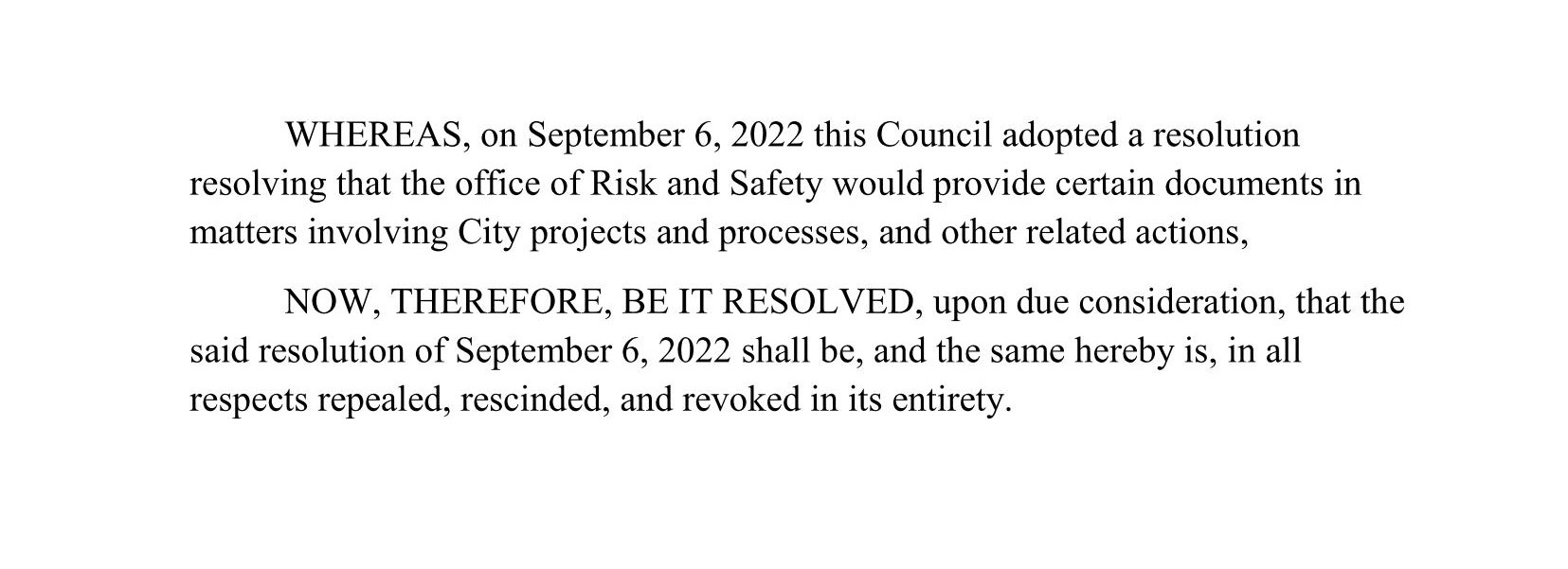
Here is the text of the resolution:
So my questions are:
What documents “involving City projects and processes, and other related actions” do readers believe he is referring to here?
Who was supposed to be the beneficiaries of these documents?The public? Other Council members? City employees?
How does this resolution address the Council’s violation of the Open Meetings Law?
Entries are not required to make any more sense than this resolution. All responses are due by April 1, 2024, December 24, 2023. I will publish the winning interpretation!
[JK: Architect Jim Martinez has a long history of trying to address the truck traffic issues in our city. Here are some of his thoughts.]
To my knowledge, this discussion on truck routes and bypasses has been going on since 2005. In all fairness to those residents who can remember during the 1960’s when a plan was proposed to connect Route 50 as a truck bypass access arterial from points north and east to points west by demolishing most of Franklin Street in Franklin Square, this issue probably seems familiar. Fortunately, this plan was foiled by several of our early preservationists and businesspeople and was discarded. At the time, the city also considered a plan by the Holiday Inn to build an addition to the Canfield Casino in Congress Park. Desperate times, desperate measures.
During the 2005 election season, truck traffic on Washington Street, a New York State Department of Transportation (NYSDOT) route, was being challenged by residents regarding oversized vehicles. With a little research, it was quickly determined that Washington Street was not a designated NYS Route for oversized Special Dimension Vehicles (SDV). While a truck route, the connecting route from our only Qualifying Highway (I87) to points west was and still is Van Dam Street as noted in their first of these two documents; https://www.dot.ny.gov/divisions/operating/oom/transportation-systems/repository/Truck%20Book%202020.pdf ; https://www.dot.ny.gov/nypermits/repository/perm71b.pdf.
The conundrum for residents addressing all other vehicles not distinguished with the numbers ‘53 painted on their trailers is that trucks must service all our businesses and properties within the city limits. Believing that truck traffic should stay on course within designated corridors is as impractical as imagining cyclists staying within the recently inaugurated bicycle lanes that service less than 5% of our streets.
After much discussion in 2006 regarding the SDVs turning onto Washington Street from Broadway, hopping the curb at Starbucks, often resulting in traffic on Washington to illegally back up, the city devised a plan to eliminate parking on lower Washington Street, narrow the sidewalk against the Brause Building for the large rigs to manage the turn. Unfortunately, it resulted in the crosswalk from the east side of Broadway terminating in the street as opposed to a safe refuge on the sidewalk. Since that plan was constituted, the SDVs still travel on the narrow Washington Street, whose structures are denser and closer to the street than the state-designated route of Van Dam Street.
The larger trucks were once routinely stopped and inspected for safety and manifest destinations. I can remember Saratoga Springs Officer Chowski flagging vehicles off Route 50 to a weigh station off Excelsior and later further south at the SPAC parking lots. It should be mentioned that there was also an audacious proposal to place a truck inspection station in front of Yaddo. That idea was summarily dashed when it was recognized that the trucks were on the other side of the city, the physical constraints of that location would not permit such an activity, and most importantly, the city did not own the land, it was already restricted by New York State.
I can sympathize with the residents of Van Dam Street, both those who have been there for some time and those recent to the street. Every neighborhood has issues, whether it’s traffic or parking, but we lived in one of the great small cities, and one must go back decades to recall when this funkier, quieter community was struggling to promote itself to attract businesses and new residents. This recent ill-conceived restriction of truck traffic without consultation and approval of the NYSDOT is unfortunate, and this last-minute neighborhood request in December before the Council expresses nothing less than a Hail Mary toss before the clock runs out.
I should mention the truck bypass route once envisioned through pristine wetlands and crane rookeries in the New York State Park that would not have addressed any of today’s concerns. Like the proposed Inspection Station at Yaddo, the trucks of concern are on the other side of the city. Today, the SDVs travel legally on Route 50 to Fenlon Street, then to Route 9 south to Exit 13. In a perfect world, all trucks would follow the same route. We all know better. The destinations for many 48′ and shorter transports throughout our city prevent this utopian idea.
Lastly, we are fortunate to have PS Commissioner Lew Benton and PS Commissioner Christian Mathiesen for their invaluable measured knowledge and experience in this matter. As always, thank you, John Kaufmann, for providing this community with your dedicated journalism that always provides more to the table for understanding.
At the December 5, 2023, Saratoga Springs City Council meeting, Public Works Commissioner Jason Golub expressed concern about adopting a restriction on truck traffic on Van Dam Street without a thoroughly researched plan.
In the following email from former Public Safety Commissioner and County Planner Lew Benton, Benton offers his research on the efficacy of limiting such traffic without the approval of the New York State Department of Transportation.
I texted Public Safety Commissioner Montagnino, asking whether he had checked with the New York State Department of State (DOT) prior to installing the signs restricting truck weight on Van Dam Street. As of this time (December 14, 2023), while Montagnino has not responded to me, I have learned he plans to contact DOT “sometime in the future.”
In a related matter, my friend, Jim Martinez, has advised me that 53-foot trucks are prohibited from using Washington Street (Route 29). Apparently, this has not been enforced.
From Lew Benton
John.
For what they’re worth, here are a few preliminary thoughts on routing Special Dimension Vehicles (SDVs) and Qualifying Access Highways.
These vehicles, or vehicle combinations, were initially authorized by the 1982 Federal Surface Transportation Assistance Act and subsequent state legislation.
Under the 1990 Omnibus Truck Safety Bill, New York authorized the use of 53 foot trailer combinations, effective November 1990. Per § 385(3)(e) of the Vehicle & Traffic Law, the 53 foot trailer combinations are restricted to the Qualifying and Access Highway system.
A Qualifying Highway is a roadway designated as part of the Surface Transportation Assistance Act (STAA) of 1982, which allows Special Dimension Vehicles (tractor trailers combinations greater than 65 feet, tractors with 28-foot tandem trailers, maxi-cubes, triple saddle mounts, stinger-steered auto carriers, and boat transporters) and 53′ trailers to use that highway and any other highway within one linear mile.
Unless otherwise specified, all Special Dimension Vehicles may use Qualifying Access Highways. In addition, Special Dimension Vehicles may also operate on all highways within one road mile of Qualifying Highways (National Network) using the most reasonable and practicable route available, except for specific safety reasons on individual routes (23 CFR 658.19). The National Network consists of all Interstates plus specifically designated other highways, including most state highways.
The confluence here in Saratoga Springs of several state and interstate components (9, 9N, 29, 50, I 87) of the National Highway Network resulted in several city-owned and maintained street segments designated an “Access Highway.” Van Dam Street is so designated.
Local government has diminished authority to regulate these local access roads and streets. Imposing a weight limitation on a local access road first requires the designation of an appropriate alternative route and approval by the NYS Department of Transportation Regional Office.
It seems inconceivable that the City Council would post a local “access” roadway – as it was apparently authorized by an amendment to the City Code at its last meeting – without prior approval of the DOT. I do not know what alternate route the Council may have asked DOT. At this writing the 5 Ton Limit signs are posted on Van Dam immediately next to the posted Truck Route signs.
If DOT does not approve the Council’s action, the proposed weight limit will be unenforceable.
Perhaps the entire community and the Council members would benefit from a review of all currently designated access roads in the city, how some have been altered over time, the process necessary to amend the system, and other pertinent matters. Such a review might also include a brief history of the several by-pass proposals and initiatives that have been undertaken since 1980.
Finally, I note that V & T Law enforcement and commercial truck inspections, as measured by the number of citations issued and fines collected, seem to have declined precipitously.
In the late 80s and early 90s, following the establishment of a well-trained and equipped traffic safety unit, V & T and overweight and unsafe truck fine revenue was as high as $225,000 annually. The number of traffic citations issued annually by the SSPD increased from an average of 2,145 before the Traffic Safety Division came online in 1988 to nearly 3,300. In 1993, 46,00 tickets were issued. Vehicular accidents and personal injury accidents declined to ten-year lows. Today, that revenue line has fallen to $30,000.
Then, Truck Fines appeared in the city budget as a separate line. That line is long gone. The Traffic Safety Division, as originally constituted, was abolished at some point in time. I do not know when or why.
The December 5, 2023, Saratoga Springs City Council meeting was yet another example of mindless accusations and poorly considered actions by Council members.
The issue was limiting truck traffic on Van Dam Street by placing a 5 ton weight limit on trucks using that thoroughfare.
Following the public comment period at which many of the residents of Van Dam pleaded with the Council to limit truck traffic there, Mayor Ron Kim accused one of his opponents in the last election, Chris Mathiesen of “illegal” behavior in somehow making Van Dam Street a truck route years ago. His accusation was based on unsubstantiated allegations. [JK: Chris’s response is at the end of this post.]
Kim claimed that a letter written by Chris Mathiesen, the Commissioner of Public Safety at the time, to the New York State Department of Transportation (DOT) in 2014 somehow directed DOT to make Van Dam into a truck route.
During his spirited accusations regarding Mathiesen, Kim disclosed that he did not actually have a copy of the letter he cited as evidence, nor had he apparently seen one. It was also evident that he had not had the courtesy of discussing the matter with Mathiesen before making his public accusations.
All of this performance was for the benefit of the many people from Van Dam Street who had addressed the Council on their desire to place a weight limit on trucks allowed to access their street.
A History Of Van Dam Street and the City’s Truck Problems
One route trucks take traveling from the New York State Thruway east to the Adirondack Northway is through Saratoga Springs. For decades Van Dam Street has been one of the roads trucks take to get through the city. In the late 1970s, my wife and I looked at a house on Van Dam Street as a possible home for us. Knowing that the street was frequently used as a truck route, though, we decided not to pursue the purchase. This pre-dated by many years, Mathiesen’s terms as Public Safety Commissioner.
The idea that Mathiesen was responsible for making Van Dam into a truck route is patently false.
I spoke to Chris about what actually happened.
Washington Street is a state road (NYS Route 29) and is a state-designated truck route. The road is narrow. Even narrower than Van Dam St. It ends in a T intersection at Broadway (by Starbucks). The increased truck traffic over the years has made life on Washington Street challenging for those homeowners. In many ways, the problems for homeowners on Washington Street were even worse than those on Van Dam. In addition, the maneuvering trucks had to do to negotiate the turn onto Broadway from Washington was notorious. Sidewalks at that intersection were frequently in need of repair as trucks would routinely go up over them to make the turn. I use the past tense since construction has kept that stretch of Washington closed recently. This could maybe account for the complaints of Van Dam street residents that truck traffic on their street had increased.
To his credit (no good deed goes unpunished), Chris attempted to see how to ease the truck problems. He wrote to NYSDOT advising them of the streets currently used for truck traffic, including Van Dam. He sought their advice on how to ease the city’s truck problems. Clearly, Van Dam would be part of a possibly better design.
The critical point here is that Van Dam was already a truck route. It was reckless and without foundation for Kim to blame Mathiesen for the truck problems on Van Dam, let alone say that he did something “illegal.”
Here is a twelve-minute excerpt from the meeting of the discussion.
I understand the frustration and anger expressed by the residents of Van Dam. Still, Van Dam intersects with Broadway beyond the north end of the downtown business district and connects quickly to the arterial leading to the Northway. Washington Street, in contrast, dumps truck traffic directly into the middle of downtown. It’s hard not to agree that, given bad choices, Van Dam makes sense as one of the city’s truck routes.
Finance Commissioner Sanghvi rightly asked what happens next if trucks can’t use Van Dam. Where will they go? Public Works Commissioner Jason Golub expressed reservations when the item came up later on the agenda for a vote. He thoughtfully suggested that before proceeding, there was a need for a thoroughly thought-out plan.
Nevertheless, succumbing to the compelling and emotional pleas of the Van Dam Street homeowners, the Council ignored these issues and approved the weight limit for their street. I have to express sympathy for the people of Washington Street who will now bear the burden of even more truck traffic, as will downtown Broadway.
A Skeptical Blogger Ruminates About Trucks
The problem of truck traffic has plagued this city for decades. At some point, the State Park and DOT were approached about building a truck route at the Southern end of the state park in order to bypass downtown Saratoga Springs. The response was a resounding no. There are extensive wetlands in that area, and the park does not want the noise of trucks to be part of its environment.
Bill McTygue has recently garnered headlines in the Daily Gazette by resurrecting this plan for a truck route.
Given the history of this problem, this blogger is highly skeptical that this solution will be any more viable now than it was when it was proposed and dropped years ago. I noted that when McTygue spoke to the Council, he was careful to observe the impact on Washington Street that removing trucks from Van Dam would have.
Congratulations but……..
I congratulate the Van Dam homeowners on their success at the December 5, 2023 meeting. Their victory, however, if sustained, comes at the cost of making life for those who live on Washington Street even more difficult and will negatively impact Broadway and downtown Saratoga. It remains to be seen, though, if this resolution will be sustainable. Not only will the new Council now have to deal with the fallout from this Council’s poorly thought out action, but it has yet to be seen if DOT will allow this to happen.
Chris Mathiesen’s Statement
[This was a letter he sent to Saratoga Today]
In particular, I addressed one of the attacks on my administration as Public Safety Commissioner during my term in office (2012-2017).
It should also be noted that Mayor Kim’s frequent criticism of the Police Chief’s decision to reduce the Traffic Division of the SSPD is unfair. I have offered to sit down with the Mayor to discuss the reasons for that decision. He has continued to ignore my offers.
The letter is below:
December 6, 2023
To: Saratoga Springs City Council
RE: Van Dam Street Truck Traffic
After attending last night’s Saratoga Springs City Council meeting, I did some research today. I have been able to establish the following:
Van Dam Street has been a Designated Access Highway for truck travel since 1989. No change was made regarding that designation during my term in office as Commissioner of Public Safety (2012-2017).
I did send to the NYS Department of Transportation letters on November 18, 2014 and March 4, 2015 to inquire whether the Washington Street/Route 29 corridor from West Avenue to Broadway could be restricted so that large trucks could no longer use that state route. This was one of a number of suggestions that we were considering, including one proposal that would eliminate east-to-west truck traffic on Lake Avenue.
Due to the lack of cooperation from the Town of Wilton, the plan to eliminate east-to-west traffic on Lake Avenue was not successful.
Any plan to change truck access to Washington Street/Route 29 would have required approval from the City Council in coordination with the NYS Department of Transportation. Our inquiry never advanced that far. Because the elimination of truck access on Washington Street/Route 29 would have resulted in that traffic being transferred to the already burdened Church Street/Van Dam Street corridor, we were reluctant to proceed and, especially after talking to Van Dam Street neighbors, we decided not to pursue that option.
The NYS Department of Transportation verifies that there was no change in designation of the Van Dam Street as a Designated Access Highway during my term in office. The actions that Mayor Kim claimed to have occurred as a result of my letters did not take place. Also, Washington Street/Route 29 continues to be a truck route through our west side to this day.
There were no actions taken by the NYS DOT regarding Van Dam Street during my term in office and thus no illegal activity on my part despite the remarks made by Council members during last night’s meeting. Council members have every right to make inquiries with state agencies. As Commissioner, I was in no position to negotiate with the NYS DOT but my department was most certainly entitled to gather facts on what the City’s options were on this most important topic. Had we decided to pursue this issue, the Mayor, the City attorney and the entire City Council would have been part of any formal negotiation with NYS DOT.
In summary, there were no changes in the designation of Van Dam Street as a Designated Access Highway during my administration. The were no ‘illegal’ or inappropriate actions taken by me or by the NYS DOT regarding the truck use on Van Dam Street. Truck access for both the Washington Street/Route 29 corridor and Church Street/Van Dam Street were, up until Tuesday evening, exactly what they were when I came into office in 2012.
I am concerned about the actions that the Council took on Tuesday night. There seems to be no coordination with the NYS DOT regarding the sudden imposition of the 5 ton weight limit. Van Dam Street continues to be a Designated Access Highway which is inconsistent with the Council’s action. Also, there does not seem to be a full appreciation for the disruption that this action will cause and the sudden burden on Washington Street/Route 29 (which is currently closed to truck traffic), Church Street/Route 9N, and Broadway as more trucks will be required to take those routes.
I sympathize with the Van Dam Street residents and I can empathize with current and future Council members having to deal with a situation for which there seems to be no reasonable solution. Good luck to you all.
On November 28, 2023, the Saratoga Springs City Council held a special meeting to deal with the 2024 city budget, which, according to the city charter, must be passed on or before November 30. The budget proposal to move money for Risk and Safety from the Mayor’s office to Accounts and the lack of funding for a second City Attorney continued to be the focus of confusing and contentious discussions during the meeting. In addition it appears Finance Commissioner Sanghvi’s budget exceeds New York State’s tax levy limit, and she did not follow proper procedure to do an override.
The Rushed and Messy Deal Between Kim and Moran to Move Risk and Safety Floundered
I attended the meeting to voice concerns about the mishandling of Risk and Safety’s reorganization and the lack of funding in the budget for a second City Attorney.
I asked Commissioner Sanghvi why she was moving the money for Risk and Safety into the Accounts Department. Her answer was because Mayor Kim and Accounts Commissioner Moran asked her to. I fully believe that that is why she did it. Commissioner Sanghvi seems legitimately ignorant of the inadequacy of this answer. It apparently never occurred to her to consider whether this was in the city’s best interest and to have a public discussion at the Council table about this before acquiescing to their request . Just because Kim and Moran want something does not necessarily make whatever they want a great idea.
Mayor Kim made an odd argument to defend his support of the move. According to Kim (see video), he supports moving Risk and Safety out of his office because the citizens voted in support of that in the last election. An incredulous Jane Weihe went to the microphone to verify that the Mayor had actually said this. The Mayor doubled down.
In the end Commissioner Sanghvi’s effort to help Mayor Kim and Commissioner Moran reorganize the city’s handling of Risk and Safety was temporarily derailed.
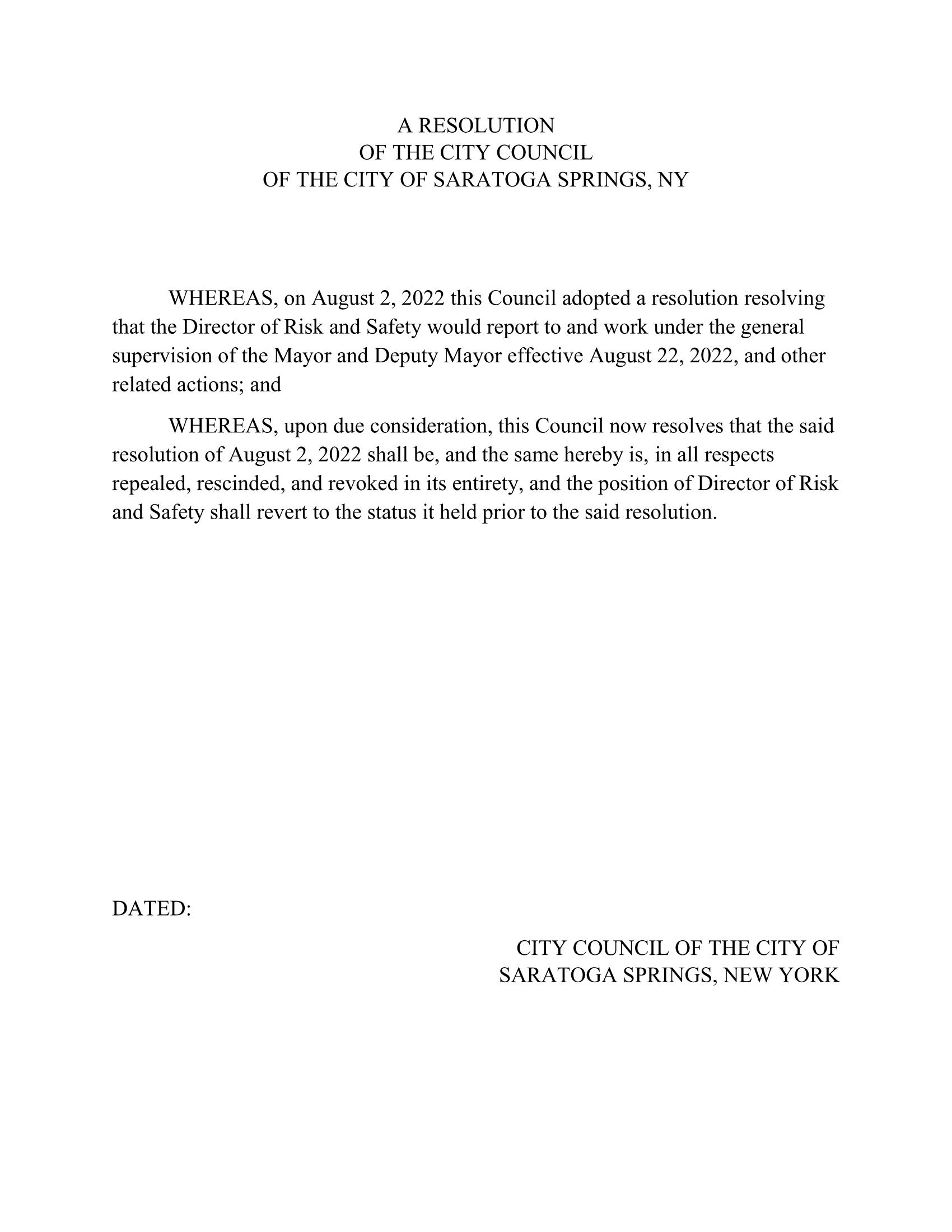
The problem was the Council had passed a resolution in August of 2022 that explicitly moved Risk and Safety into the Mayor’s office. It was improper for Sanghvi to ignore that resolution and think she could relocate those responsibilities simply by moving money around in her budget.
Public Works Commissioner Jason Golub pointed out that this was a problem (see video). He noted that until the Council formally nullified the existing resolution passed by the Council that assigned Risk and Safety to the Mayor’s office, it would be premature to establish funding for it in the Accounts Department.
Golub’s opinion prevailed (Sanghvi’s frustration with this was evident), and the Council passed a last-minute amendment to the budget that moved the money for Risk and Safety back to the Mayor’s office.
Unfortunately, Kim, Moran, and Sanghvi merely planned to put a resolution on the agenda for the next Council meeting on December 5 to rescind the Council’s 2022 resolution and then move the money around again after that was done-something that can’t be done until 2024, though. I will be reporting on the problems with that resolution in the next blog.
This is reflective of the chronic problems that plague this Council. They lack the interest and/or the skill set to take the time to think through what they want to do and how best to do it. This means they repeatedly end up using an enormous amount of time at meetings flailing around trying to figure things out that should have been resolved before they brought the measure to the Council table.
The Mishandling Of Funding for a Second Attorney
I also asked Sanghvi why the second City Attorney’s position had been defunded in her budget. The city has had two City Attorneys, except for a brief period under Mayor Kim, since 1973.
She answered by observing that the Assistant City Attorney was leaving on December 1, 2023, so this was a good time to deal with the position of a second attorney and that she had a “plan.”
The “plan” the Commissioner claimed to have was to fund the second City Attorney through something called an “assignment”.
An “assignment” is a procedure whereby money is set aside outside of the budget for future anticipated expenses. So, for example, there is an assignment to pay for additional police should public safety hire new officers. If there are new hires, money will be pulled out of the assignment and included in the budget.
Aside from the fact that assignments are best used for non-reoccurring expenses, this “assignment” has nothing to do with funding a second attorney.
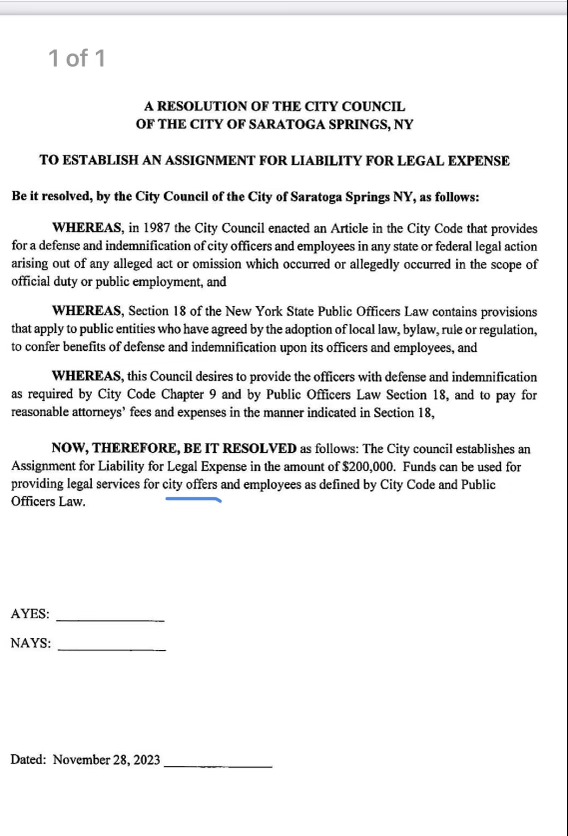
The assignment Sanghvi referred to was described in the “Resolution to Establish an Assignment for Liability for Legal Expense.” A careful reading of this resolution reveals that it is about setting aside money to cover the legal costs for outside counsel for city officials and employees should they be sued over activities associated with their official duties. It sets aside $200,000.00.
In her remarks, Sanghvi took the opportunity to recite once more the bills the city has had to pay for lawyers defending elected officials and employees snared by the Attorney General’s investigation of the treatment of Black Lives Matter. This is a list that she and Mayor Kim enjoy reciting in order to try to shame the previous administration. I am stunned that Sanghvi understands so little about the language in this resolution that she apparently authored. I repeat: Nothing in the resolution is relevant to paying for a second city attorney’s salary! This resolution deals with contingency funds to pay outside counsel for officials and employees who might be sued.
Here is a video of her remarks. Strangely, her description properly describes the text, which has nothing to do with hiring a second attorney.
I am hopeful that the new administration will be able to find a way to pay for a second attorney in spite of the fact that the 2024 budget adopted does not include it. This is a stark example of Commissioner Sanghvi’s inability to manage the city’s finances properly.
The Budget Passes-Sort of…..
The 2024 budget was passed at this meeting with Moran, Sanghvi and Golub voting in favor, Kim abstaining, and Montagnino voting no. This budget, however, which raises taxes for the second year in a row, appears to have a tax levy that exceeds the New York State limit. According to “The Property Tax Gap Guidelines for Implementation” put out by the New York State Department of Taxations and New York State Department of State:
Local governments may override the tax levy limit only by first passing a local law that allows for the tax levy limit to be exceeded…The override vote must precede the vote on adoption of the budget…[and] any such law or resolution must contain language that clearly overrides the levy limit.
On the verge of leaving office, defeated Saratoga Springs Mayor Ron Kim seems ready to assist his (at the moment) ally, Accounts Commissioner Dillon Moran, in Moran’s campaign to expand his power over the city. Moran has two items on his agenda for the December 5, 2023, City Council meeting that, if adopted, will transfer significant power and authority from the Mayor’s Office to Moran’s Accounts Department.
One resolution would move Risk and Safety responsibilities from the Mayor’s office back to Accounts. The other resolution would transfer responsibility for dealing with the New York State Liquor Authority from the Mayor’s office to Moran’s department.
Mayor Kim’s Sudden Conversion Over Who Should Oversee Risk And Safety
Had he not lost the election, Kim would never have allowed Risk and Safety to be moved from his office. Now, as he leaves office, he champions Moran’s cause.
Last year, Kim had doggedly pursued seizing Risk and Safety from the Accounts Department in a campaign that spanned three different Council meetings and hours of bitter argument. Kim finally succeeded in August of 2022. Consider this June 7, 2022, meeting video for a flavor of that bitter campaign (It’s very long).
At the upcoming Council meeting on December 5, 2023, Dillon Moran has a resolution to transfer Risk and Safety back to the Accounts department.
At the November 28, 2023, special Council meeting, Kim asserted that he still believed Risk and Safety should be in his office but oddly claimed that the recent election for Mayor centered around the question of where Risk and Safety should be. According to him, his defeat was a statement by voters that it should be in the Accounts Department. I find this utterly bizarre. While I think the decision by the city’s insurer, Travelers, not to continue to underwrite the city due to the mismanagement of Risk and Safety contributed to Kim’s loss, nowhere during his race did anyone advocate moving Risk and Safety to the Accounts Department.
Kim was caught in a trap of his own making. Having doggedly pursued control over Risk and Safety on the basis that it should be integrated with the City Attorney, he was hard-pressed to come up with a credible argument as to why, organizationally, it should be moved back to Accounts. I guess this explains his bizarre attempt to try to use the election to explain his change of mind.
Moran Can’t Even Craft A Resolution Properly
It is worth looking at Moran’s resolutions. A proper resolution ends with a “resolved” clause indicating the proposed action of the resolution. This follows the “whereas” clauses indicating why the action is taking place.
Consider this resolution on Risk and Safety apparently crafted by Moran.( His resolution regarding who should communicate with the State Liquor Authority has the same problem.)
The resolutions regarding Risk and Safety (actually, there are two on his agenda; who knows what he means to do with the two of them) and the SLA suffer from Moran’s inability to craft a resolution properly. Moran is not an attorney, and the prudent thing for him to have done would have been to consult the City Attorney.
It is absolutely chilling to think that he is going to be responsible for the Office of Risk and Safety.
Moran’s Resolution To Move Communicating with the New York State Liquor Authority (SLA) From The Mayor’s Office To His
Moran, who owns a tiny stake in Druthers bar and restaurant and who is a denizen of the downtown bars, has a resolution that places control over the city’s relations with the New York State Liquor Authority in his office. As a liquor license is fundamental to bars and restaurants, this positions him as the czar these businesses must deal with when seeking a new or a renewal of their liquor license.
Last December, the Council passed a resolution that instructed the City Attorney, under the Mayor’s supervision, to write to the SLA when a liquor license was applied for, up for renewal, or modification to ask the SLA to prohibit the sale of alcohol beyond 2 am as a condition for granting the liquor license request. Moran will offer a resolution Tuesday night, nullifying the request for a 2AM closing. In addition, his new resolution gives the City Clerk (Moran is the city clerk), the responsibility of dealing with the SLA in all licensing matters.
WHEREAS, upon due consideration, the Council resolves that the City Clerk shall have authority, in his/her discretion, to promptly respond to the SLA in writing regarding an establishment’s liquor license, renewal of a liquor license, or modification or amendment of a liquor license and waivers of statutory 30-day advance notices.
Moran motion
There has been a broad consensus to close the bars earlier due to both the cost of police overtime to cover the city’s bar area that late and to spare the police the abuse they must endure during those late-night hours.
I texted Moran asking that he explain why he wants to reverse the city’s efforts to require bars to close earlier than the current 4:00 am time. He responded as follows:
“Can you explain your constant lies? Repeated, constant and willful lies about me?







 Saratoga Springs Politics